Steppe Eagle and Jerdon’s Baza in Saiha, Mizoram
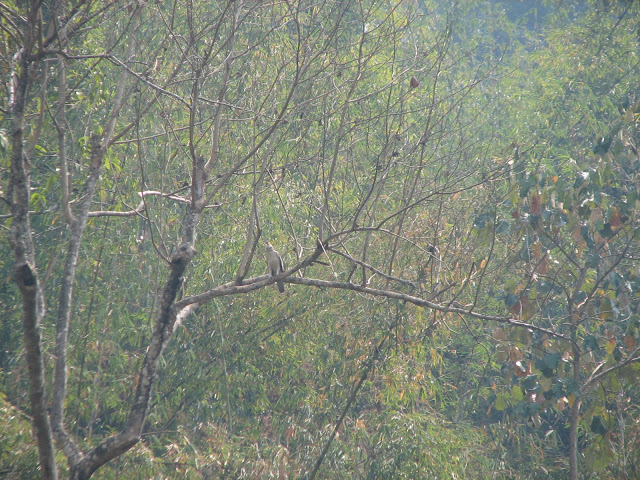
Another post that finds place in Indian Birds : 7(4). Introduction North-eastern India, and Mizoram: North-eastern India, comprising the states of Assam, Arunachal Pradesh, Nagaland, Manipur, Mizoram, Meghalaya, and Tripura, forms part of a rich biogeographic unit and is among the biodiversity “Hotspots” of the world (Choudhury 1999; Myers et al . 2000; Ved & Lalramnuna 2008). Within the hotspot our efforts are concentrated in the state of Mizoram. Mizoram (21º58’N–24º35’N, 91º15’E–93º29’E) covers an area of 21,081 kms 2 ( Anonymous 2006). In broad terms, the forests of Mizoram are classified as ‘Cachar Tropical Evergreen (IB/C3),’ and ‘Cachar semi evergreen (2B/C2),’ by Champion & Seth (1964). Its land and people have a tendency to being somewhat detached, obscure, and unknown, finding scarce mention in literature, whether historical, anthropological, or ecological (Singh 1996). Saiha district, located in extreme southern Mizoram, covers an area of 1,965.81 kms 2 ...