Posts

Showing posts with the label History

History in Hyderabad

Image
What I learnt from the History Literature Festival?  Not long after Eesha and I reached the venue I realised that the impromptu decision to take leave from school and book seats on the only available train to Hyderabad to attend a literature festival focussing on history was a good one. At the school students often ask us why they need to learn history at all - in other words why we are doing what we are doing! Incidentally we also teach history! Over the course of 3 days we listened to people talk about not only the history of the Deccan but also history of businesses, history of music, history of cinema, history of  arts, history of WW2, and other facets of history. It was also heartening to see some of the students ( especially grade 8 ) of HPS ( the venue ) actively participate, to make use of the opportunity at their doorstep. The overall vibes were positive - vibes we could not have experienced online. Some of the speakers were ( for lack of another term ) high quality...

Sanskrit University

Image
  Gothic Architecture in the heart of Banaras For Banaras’ past one goes to Diana L Eck’s Banaras: City of Light This is what she writes on the place In education, the British years brought a change from the ancient pandit-student pattern of learning which had predominated in Kashi for 2,500 years. In 1791, the Governor-General, Warren Hastings, who had presumably recovered from the indignities of his flight from Banaras, approved the proposal of Jonathan Duncan for a Sanskrit College in Banaras, where Sanskrit texts would be collected and pandits employed. In 1853, the present buildings for this college were erected in a Gothic style strikingly out of place in Banaras. The Sanskrit College, preserving the most traditional Hindi learning, was oddly called Queen’s College. This is what James Kennedy had to say about the place in Life and work in Benares and Kumaon (Shristi Book Distributors, New Delhi, 978-93-85088-44-5) In 1853 a very fine Gothic structure, said to b...

Lathiya (Ghazipur)

Image
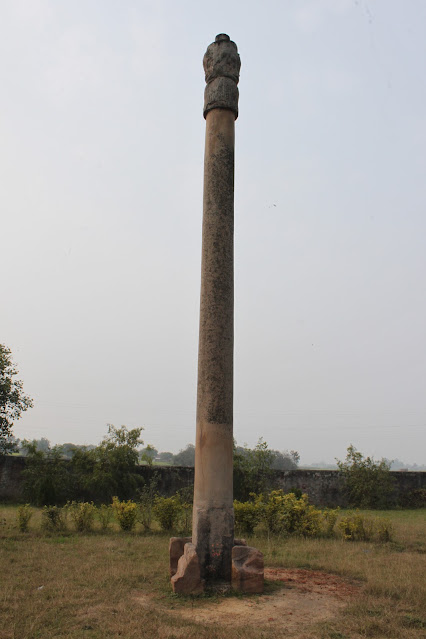
Pillars (Laats) of ancient times surviving in the region are today associated with Ashoka (the great) and Alexandar Cunningham for very different reasons. One for the encouragement and support that enabled the pillars to come into existence in the first place and the other for taking steps to protect what little remained of those times. There are questions on the age of the pillars and hence Ashoka's association. However, there appears to be no questions on Cunningham's efforts. This particular site (near Zamania) while being large and open when compared to couple of others that we have been to offered no information of any sorts. It boasts of a treed pathway, large walled compound, few benches (not in a great state) and one board in a condition that rendered any sort of reading and comprehending impossible! The pillar has smoothened with rains and heat of the centuries. Towards the top the age driven withering is visible. The pillar stands, somewhat tilted in isolation.  Faith...

Love for history

Image
Making history come alive The Hindu – EDGE – published this piece on 22 nd January, 2018. It is an abridged version of the piece published by Teacher Plus in its November 2017 issue. The piece in EDGE here and Teacher Plus here . Thanks are due to Shalini and The Hindu. ‘ She is not interested in museums ’, a friend said, of his daughter. He left me wondering. The history lover in me was not very happy. I frequent museums and try to savour those at places I visit. Here I speak not just of large and exquisite collections like the ones at the Prince of Wales Museum in Bombay but also of smaller museums. Museums in capitals of Meghalaya, Mizoram and Nagaland have taught me about the homes and festivals of people there, the clothes they once wove and wore, their fishing and cultivation practices and more. Today, we also have privately owned museums. Some of them like the textile and vessel museums at Ahmedabad boast of very focused and novel collections. Then, of...

Museums

Image
Museums as learning spaces This piece is published in the November 2017 issue of Teacher Plus here . Thanks are due to the team at Teacher Plus and the museums all over for allowing my love for history to not only stay alive but flourish.  ‘ She is not interested in museums ’, a friend said, of his daughter. He left me wondering. The history lover in me was not very happy. I frequent museums and try to savour those at places I visit. Here I speak not just of large and exquisite collections like the ones  at the Prince of Wales Museum in Bombay o r the National Museum in New Delhi. I have learnt of Meghalaya, Mizoram and Nagaland from museums in their capitals. They have taught me about the homes and festivals of people there, the clothes they once wove and wore, their fishing and cultivation practices and more. Today we also have a range of private museums. Some of these like the textile  and vessel museums  at Ahmedabad boast of very focused and nove...

History and Travel

Image
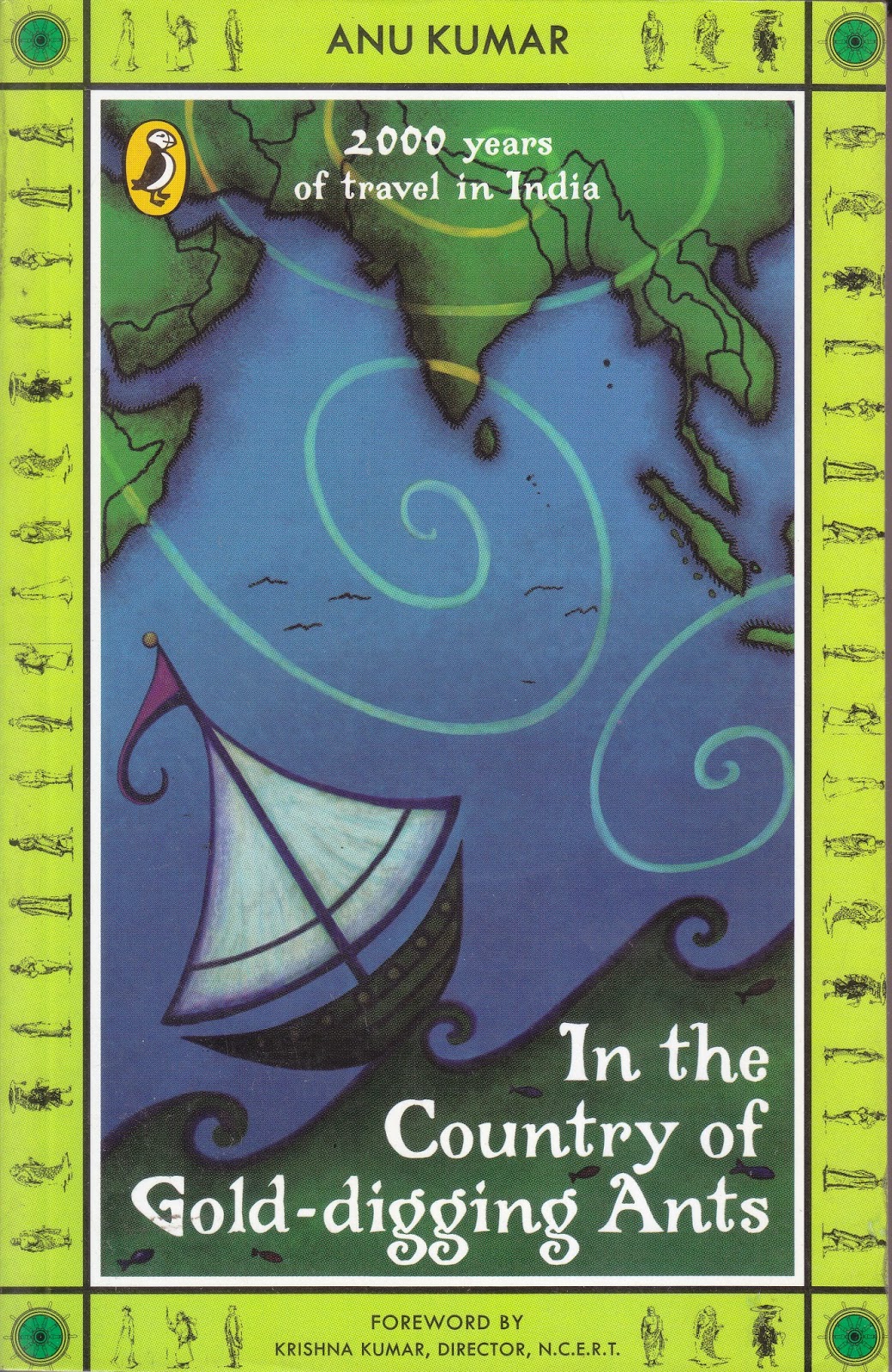
The Book In the County of Gold-digging Ants 2,000 years of travel in India Puffin Books Published by Penguin Books India 2009 The Author Anu Kumar The Cover The Reviews Share 2 reviews I found online and quite agree with the later that says that the book is for those aged 8 – 80; if one finds the details missing one can launch off online from the leads the book provides. Saffron Tree Good Books The Musings Intriguing how even then It was difficult to understand ‘India’ on account of treating it as one unit.  (for some reason recalled Javed Akhtar’s lyrics ) . We are an enigma? Extreme inequality was more of a norm than an exception. A friend shared of how after all the ‘development actions’ we have managed to reach the inequality levels we were at, a century ago! Halide Edib Haldie contrasted the poverty and inadequacy of primary education with the limitless riches of the universities she had visited, in A...

History ever fascinates

Image
Picked up ' Gulbadan' from a 'Book Sale' on account of love for history and interesting cover besides the tone of the author in the initial pages; she translates the name to 'rose-body'. Gulbadan was the youngest daughter of Babur, first Mughal emperor of India and lived almost through three reigns: her father Babur’s, her brother Humayun’s and her nephew Akbar’s, till two years of his death. This I find interesting on account of my interest in wildlife; recent reading of Valmik Thapar's Exotic Aliens : The Lion and The Cheetah in India  brought forth the clear distinction between 'maintained forests' and 'natural wilderness' during those times! As Akbar grew older and the Empire more settled, hunting took the place of battles; it, too, was cruel. Hundreds of soldiers would surround some chosen miles of jungle and gradually beat inwards, driving the animals until they were in a vast net. The Emperor went in first to take his...