Posts

Showing posts with the label Conservation Education

Why I do not stress on Conservation Education at school; now!

All effort, no yield This piece finds place in The Hindu EDGE on 1 st July . Thanks are due to the team there. Few weeks ago, friends, who work to get children to fall in love with books and stories, visited our school. I love reading and enjoyed being a part of the conversation as it moved from what we could do with books at our school to why books are crucial for children. As someone who, today, puts in more time with books than with friends, I found little to disagree. However, the line – ‘ world without books is poorer and dangerous ’, brought out the dilemma I had been encountering of late. I shared it with the small group: “ Do these actions tantamount to pushing our ‘agendas’ on schools and children, in this fashion? Do we do this more with children, for they do not have the space to vocally disagree? How fair is this? ” Last week, at a school in a village in Himachal Pradesh, I was reminded of the discussion. I had accompanied a friend and noticed story-bo...

Trees: At School

Image
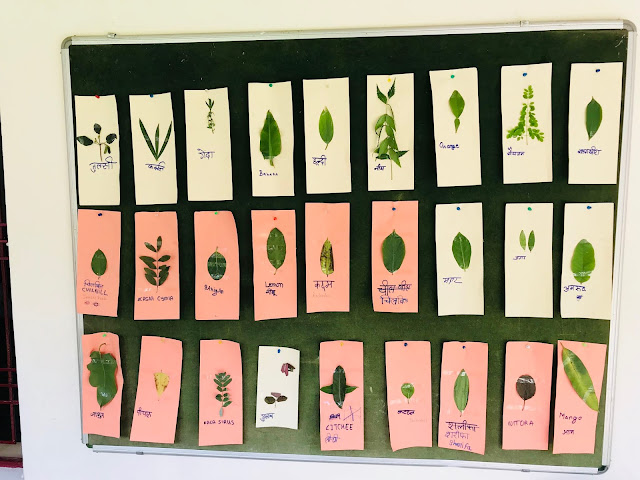
So, what do you do at school I have often been asked?  On occasions I smile, on others I respond with a 'teach English' or that 'I play and go-out with children'. At times the answer also is 'good question'.  Besides these, what I also do is see, touch and feel trees and leaves.  This was a fun day. We got moving around to fetch leaves in small groups. The groups could bring more than one leaf only if the leaves were collected from the ground. Children got the leaves, discussed which species each of these could belong to. Before writing they had to confirm these names with the uncle who helps with gardening at the school. Few cases were confusing - we had disagreements. For these we went with the uncle to the tree.  At the end our board did not have space for 2 leaves. It was fun, during the days following, to see them touch the leaves and also alter spellings.  This was another fun day. We sat in a circle just outside the scho...

Trekking with tiffin boxes

Image
Bring your own tiffin box Thanks are due to the team at The Hindu EDGE . Of course none of this would have been possible without the younger ones, colleagues and our trip-partner. “All of us will take 2 empty bottles and 2 empty tiffin boxes during the trip ”, - we shared along with details concerning warm clothes, footwear and so on. Bottles for water were fine but tiffin boxes for food! “ What is the need? ” said the looks on half of the younger faces! Leisurely walk  We were planning the annual trip for one of our classes at school – this time a trek in the Garhwal Himalayas – and were keen to do better than what we had ended up doing during the previous year , especially on the sustainability front. One sore sight had been disposal of packing material for food – this included paper, plastic and aluminium foil. A group of 40 during a 16 hour rail journey itself has the potential to generate a substantial load of trash . For this trip, we used our tiffin boxe...

Anybody can teach?

Anybody can teach? Published at Hindu EDGE here . Thanks are due to the team at Hindu EDGE. Few weeks ago, I read of a government servant, in Uttar Pradesh, holding a senior position, going to teach at a government school each Saturday. The newspaper article, of course, was highly appreciative of the ‘noble’ deed and how it would benefit the school. It also encouraged others to take up similar action. The article reminded me of a summer vacation, during school days in Gujarat, when we were supposed to teach the alphabet ( or was it numbers or both ) to under-privileged children. We were also given a book for this.   But, neither I nor my friends ‘ did ’ anything on this front. We had no idea what to do. Strangely, even schools display this behaviour. Last week, while reading a book on ‘S chools that educate differently’ I got to know of one in West Bengal which used to send 150 students, each week, to the villages. This was to ‘ reach out to the underprivilege...

Nature education today: Some questions

Image
Nature education in schools: Where do we stand?   Thanks are due to the team at Teacher Plus and the hosts and co-participants of the event for this piece published in August issue of Teacher Plus. At a recent gathering on nature education, participating school teachers raised pertinent questions, some of which I discuss briefly below. A majority of teachers were part of schools that have ‘nature’ higher on the list of values they ascribe to than ‘competition’ and boast of campuses which other ( read regular ) schools can at best dream of. Outdoors.   Most of us agree that the ‘outdoors’ present a far more conducive setting for nature education than the ‘indoors’. However, the ‘outdoors’ also warrant a different and seemingly more difficult set of skills. Walking around and recognizing, touching, smelling, tasting leaves and learning of their usage from people whose lives they are an intricate part of – all the while keeping the students hooked - is diffe...

School trips: Some questions

Image
Lessons in the outdoor This piece finds space in The Hindu – EDGE here . Acknowledgement are due to Santharam and Prashant for sharing their vast experiences, THE HINDU and Shalini for publishing and Satya for the enabling the trip and being there. Why are school trips undervalued when it comes to their potential for learning The week-long trip with class VIII students, a couple of months earlier, was a lot of fun - from being together in the rail coach to sharing tents, from running up and down the hills to swimming in stunning lakes, from visiting a butterfly museum to early morning bird walks and more. The immense potential these trips harbour as learning spaces was underscored - learning from new environments, fresh experiences, and away from the ‘regular’ schedule. Why this learning is treated secondary to class-room teaching continues to remain a mystery! Amidst the excitement, however, some elements stuck out and raised questions. On the one hand...

Textbooks

Image
Don’t always go by the textbook Thanks are due to Shalini, Teacher Plus and RK. The piece on Teacher Plus here . Some days ago a friend invited me to interact with students of class 8. He teaches science in a school that adheres to the CBSE curriculum. The topic for discussion was (Chapter: 7) Conservation of Plants and Animals. I took the textbook home to prepare and while I found the ‘story’ engaging, my first impression was that the chapter had spread itself a bit too thin – especially towards the end. However, as I re-read and began making notes some portions left me with a host of questions.   Some of these lines and my reactions I share below. ‘ Trees in the forest are cut for some of the purposes mentioned below – Ø Procuring land for cultivation Ø Building houses and factories Ø Making furniture or using wood as fuel ’ On similar lines is ‘ it is a pity that even Protected Forests are not safe because people living in the neighbourhood encro...

Conservation Education : An exercise in planning

Image
A year since the fun time at Manas with friends and rains share of the planning workshop.  The paper presented at CEE Amdavad -  here .  Education for change - online version - here  and  print version - here .  The text here talks of the same event albeit using a different tone and lens.  Thanks are due to all the participants and Aaranyak.  Should we, should we not, we discussed, and then suddenly, one by one, in a file, most of the participants walked out. Out towards the gushing river, amidst the deafening rains, with water all around us, including in the paddy fields. Later during the evening they would return to the paddy fields to listen to the symphony played by frogs. Earlier during the day the participants had gone spotting birds and the list included the Bengal Florican! They had come together to deliberate on a plausible and realistic plan for conservation education (CE) in the Manas Landscape, Assam. A long-term pl...

Education: Beyond Classes and Power-points

This finds place in Teacher Plus’ February 2017 edition. The piece on their website here and the unedited post on the blog here . Thanks are due to the teams at Teacher Plus and Centre for Experiential Education and co-participants. Co-creating Experiences Experiential Education Conclave is an annual gathering that provides opportunity to learn of the topic and interact with others exploring it. During the recent weeks as I saw fliers and then images of the 3rd edition at Gurugram I recalled with fondness the event I had attended a year ago. Going down memory lane During his session, ‘Pains in Practice of Experiential Education’, it was interesting to observe how Vishwas Parchure noticed a frame on the wall depicting multiple knots and used that observation effectively. We were asked to select a knot from the frame we identified most with. I was confused as all knots appeared the same to me. We then discussed the proverbial knots in our li...