Posts

Showing posts with the label CCA

Joining the Dots

Image
Joining the Dots Text and Photographs: Nimesh Ved and Swati Chaliha We are indebted to the people of Ungma and Longsa, and the DGZ committee for bearing our ignorance and teaching us of forests during those very wonderful days and – of course - for the very lovely pineapples. Thanks are due to friends at NEPED for sharing of Nagaland, the energies and humour. Colleagues at FES we thank for being together and for presenting the opportunity. This piece appears in the July – September 2015 issue of Hornbill ( BNHS ). Twice on the first day, the dilemma posed to us was whether we should take the tar road that snaked along the path, albeit a little further from where we had figured out the boundary lay, or cut our way through the wild growth. In both cases, after deliberation, we decided that the easier path was not the one best taken, and cut through the forest. We were walking the boundary of a Community Conserved Area (CCA) in Mokokchung district, Nagaland. CCAs are...
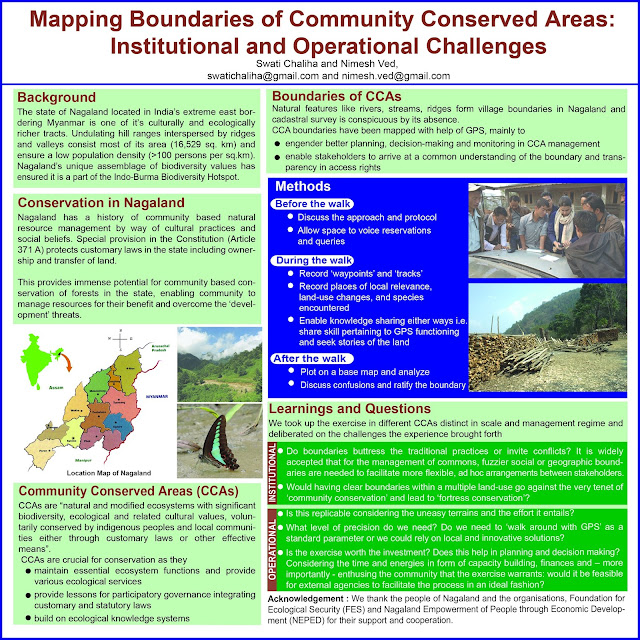
Mapping boundaries of Community Conserved Areas: Institutional and operational challenges

Image
Pleased to share a poster presented at IUFRO 2014 World Congress Congress Theme:  Forests for People Title:  Mapping boundaries of Community Conserved Areas: Institutional and operational challenges Authors:  Swati Chaliha and Nimesh Ved Abstract: Defining spatial boundaries of Community Conserved Areas (CCA) are perceived as pertinent for stakeholders to have common understanding and for laying down operational rules. In Nagaland, India assigning natural features as boundaries have been a customary practice and cadastral maps do not exist. Having CCA boundaries here is crucial in the wake of current development and conservation paradigm. Process of mapping boundary led to myriad questions. While in one CCA of Nagaland, authors with villager’s support mapped boundary by walking with GPS receivers, and data analysed using GIS; in another CCA efforts involved equipping selected villagers with skills of using GPS for mapping. In the first case, an or...

CCA: Talk at Rishi Valley

Image
Shared my meagre understanding on CCAs at Rishi Valley during a recent trip. The setting was amazing ( entire school in the evening at the assembly hall ) and am absolutely indebted to Rishi Valley for the opportunity.  Two conversations of the evening stand out. During afternoon tea one student shared that she and her friends were excited not because of the talk but because of the dinner that was to precede the talk; just in case I had any illusions. After the talk ( and questions that followed ) one student came up and as I bent down he put his hand on my shoulder and said 'shy ok - so talking like this'; his tone was very much like that of one of my closest friends.  Select slides and accompanying 'bullets' are placed below Control and management ( decision making ) rest with community Community is closely related to ecosystem  Efforts lead to conservation Not necessarily strict preservation but multiple ( flexible ) rules ...

Dikhu Green Zone

Image
Sanctuary Asia (Vol XXXIII No. 3, June 2013) carries a report 'People for Parks' by Bittu Sahgal, Lakshmy Raman, Kritika Kapadia and Mallika Narvekar (Pages 61 - 65). Placed within the report, in form of a box item, is a brief note on the Nagaland experience.   The Dikhu Green Zone In Nagaland, Community Conserved Areas (CCA) are helping to reduce hunting, forest degradation and provide valuable ecological services. CCA are natural or modified ecosystems that harbour significant biodiversity and have immense ecological and cultural value and are voluntarily protected by indigenous and local communities through customary laws or other effective means. The Nagaland Village and Area Councils Act, 1978, empowers village councils, autonomous local bodies for village administration to function according to customary practices and usages.  Conservationists, Nimesh Ved and Swati Chaliha write: ‘The Dikhu river forms the boundary between Ungma and Longsa and a commu...

Phuye - Interactions on CCA Mapping

Image
We started with a film . This would keep boredom at bay for participants who had arrived on-time as also help lay a platform for further discussions. The film " A Hunter's Tale ", that I have facilitated screenings earlier too,  held the participant's interest ~  Some of the participants then got on to identifying species in the field-guides. As we wondered on how Hoolock Gibbon and Hornbills were charismatic species from participant's perspective as well, it dawned on us that only the elders were then vocal! On asking the young participants we got to know that none of them had seen either Hoolock Gibbons ( Ashuai)  or Hornbills ~ As the participants arrived we moved on to Prayer and Introduction by the Nanga Greener Zone (NGZ) Committee; Governing body of Community Conserved Area (CCA) that spans 14 Sema villages ~ Participants had questions for us as well as the Committee. These ranged from whether GPS units would be provided for each village ...