Posts

Showing posts with the label Nagaland

An old world warrior in a new world battle

Image
Title: Second World War Sandwich Author: Digonta Bordoloi Cover: Haitenlo Semy Pan Macmilan India Price: 399/- Pages: 231 First published: 2021 ISBN: 978–93–89109–52–8 Thanks are due to Digonta Bordoloi , Pan Macmilan India , Sunny and Swati.   Background During my first visit to Nagaland, silly enough, I missed out a visit to the war memorial. The second trip, however, I made amends. The place is special. Every subsequent visit I made it a point to visit it with - time on hand. There, sitting in silence, amidst the graves, I felt a strange calm. Calm I have experienced only at a few other places. This book took me there. It again told me why the war memorial exists. What all a place which emanates peace and serenity today has seen in the past. The horror of violence and brutality at close quarters. It reminded me how little I knew of the battle that could have possibly altered a lot – including our map - had the result been otherwise. This book, a work of fiction, is a well-resea...

Joining the Dots

Image
Joining the Dots Text and Photographs: Nimesh Ved and Swati Chaliha We are indebted to the people of Ungma and Longsa, and the DGZ committee for bearing our ignorance and teaching us of forests during those very wonderful days and – of course - for the very lovely pineapples. Thanks are due to friends at NEPED for sharing of Nagaland, the energies and humour. Colleagues at FES we thank for being together and for presenting the opportunity. This piece appears in the July – September 2015 issue of Hornbill ( BNHS ). Twice on the first day, the dilemma posed to us was whether we should take the tar road that snaked along the path, albeit a little further from where we had figured out the boundary lay, or cut our way through the wild growth. In both cases, after deliberation, we decided that the easier path was not the one best taken, and cut through the forest. We were walking the boundary of a Community Conserved Area (CCA) in Mokokchung district, Nagaland. CCAs are...

Mapping boundaries of Community Conserved Areas: Institutional and operational challenges

Image
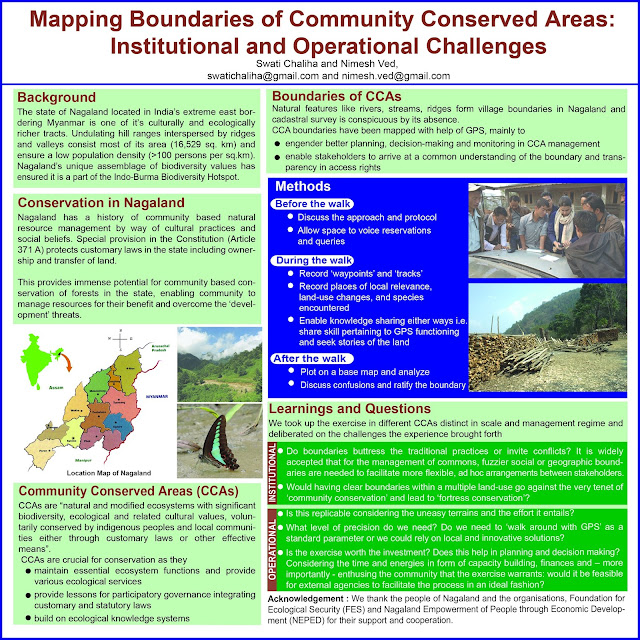
Pleased to share a poster presented at IUFRO 2014 World Congress Congress Theme:  Forests for People Title:  Mapping boundaries of Community Conserved Areas: Institutional and operational challenges Authors:  Swati Chaliha and Nimesh Ved Abstract: Defining spatial boundaries of Community Conserved Areas (CCA) are perceived as pertinent for stakeholders to have common understanding and for laying down operational rules. In Nagaland, India assigning natural features as boundaries have been a customary practice and cadastral maps do not exist. Having CCA boundaries here is crucial in the wake of current development and conservation paradigm. Process of mapping boundary led to myriad questions. While in one CCA of Nagaland, authors with villager’s support mapped boundary by walking with GPS receivers, and data analysed using GIS; in another CCA efforts involved equipping selected villagers with skills of using GPS for mapping. In the first case, an or...

Local Names : Nagaland

Image
Ao and Sema Names Ao   Ø   Asian Elephant:                Shoti Ø   Asiatic Black Bear:          Sheom (U)/ Shirem (L) Ø   Assamese Macaque:         Shoje Ø   Chinese Pangolin:            Kelap Ø   Himalayan Brown Goral: Shok Ø   Himalayan Rat:                 Chuha Ø   Himalayan Striped Squirrel:Shekshang Ø   Hoolock Gibbon:              Shin ü Each language is like a code that describes knowledge about medicinal secrets, ecological wisdom, weather and climate patterns, spiritual attitudes, and artistic and mythological histories. The Tulu language, for example, spoken by a little more than a million people preserves epic poems of the 13th century....

Weaving stories with facts

Image
This piece finds place in the February 2015 issue of Teacher Plus.  Walk in a village – a story During a visit to Rishi Valley School ( Chittoor, Andhra Pradesh ) the teachers there asked me if I was interested in addressing the junior school assembly. When I happily agreed, they warned me that the students were the most difficult bunch in the school and would not stop asking questions! I then asked the teachers what I could talk about that would be of interest to them. They suggested that I talk about life in the villages of Mizoram ( as I had spent time there ) and illustrate my talk with images, as this would be interesting to them.  I pondered a bit and thought of talking about my experiences in Nagaland, where I had during trips in the past couple of years enjoyed many a happy moment. Also I had good photographs of the place to support my talk. As I began preparing for the talk, sorting images, and jotting points I realized that the structure of my talk was...

Ferret-badger records from Mizoram, Meghalaya and Nagaland, India

Image
This note finds place in JBNHS 111(1), Jan - Apr 2014.   FERRET-BADGER RECORDS FROM MIZORAM, MEGHALAYA AND NAGALAND, INDIA Nimesh Ved 1 and Laltlanhlua Zathang 2 1 Srinivas Nagar, Padmarao Nagar, Secunderabad , Telangana, 500 061, India. Email: Nimesh.ved@gmail.com 2 Tuikal South, Aizawl, Mizoram 796 001, India. Email: Tlana_z@yahoo.com   Introduction In India ferret-badgers are restricted to the tropical and subtropical forests and grasslands of northeast India (Datta 2008). This region, comprising the states of Assam, Aru­nachal Pradesh, Nagaland, Manipur, Mizoram, Meghalaya, and Tripura, forms a part of the biodiversity “hotspots” of the world (My­ers et al. 2000; Ved and Lalramnuna 2008). Ferret-badgers are nocturnal, usually active at dusk. Like most badgers they live in holes dug by themselves or in burrows of other animals, and in rock crevices. They are good climbers and often sleep on the branches of trees. They are omnivorous and known ...