Posts

Showing posts with the label Education

News on the board

A World of Possibilities Thanks to the team at The Hindu. Published here .  Recently, a board was installed at our institution to to put up newspaper articles. The idea was to encourage students and teachers to read newspapers. Actually, to just read. We began with an open mind and four dailies. We were keen to get to know of the developments in the country and the subjects we pursued. We began by reading and rereading the newspapers, short-listing articles, pondering over them, and neatly putting them up on the boards. In course of a few weeks, we increased the board area and made it more reader-friendly. ‘ Shall we read? ’ talked of parents’ and bookstores’ efforts to increase reading. We were doing our bit here. Next came the themes. AI is extensively written about these days. We put up articles on how it reinforces gender and caste biases ( Sociology ) or even on how it discourages creativity . We also had articles on the water guzzling and carbon-footprint ( ESD ) that go into...

Children and us, today

Children in a changing world  During the past few years our society has undergone humongous changes. Some of these changes have made impacts way beyond what is apparent to the eye and what we accept. They have led to many of our age old practices, and with them the accompanying wisdom, disappear quickly and silently. Today, we are a society that has, at large, embraced two religions - markets and technology. Advertisements and algorithms are driving our lives and individuals have been replaced by consumers. The majority, if not all, of these consumers act in a uniform manner and many of their actions have us questioning some of the classical theories we have grown up with. The law of Diminishing Marginal Utility (DMU) for example does not seem to be effective in the context of entertainment and food when reels and home-deliveries are available at our fingertips. How have these changes impacted children? Today, the children seek freedom and abhor rules - yet they appear out of depth...

Caste in the classroom

Image
Thanks to the team at  Teacher Plus  for publishing this in the March 2026 issue.  Meeting the Savarnas by Ravikant Kisana resonated in a manner than not many books do. It reminded me of some of the conversations I had had, took me back to some situations I had been a part of, had me reread some sections, got me talking excitedly about the subject with friends, and make notes. This is a book school teachers will do good to read. It may help broaden their horizons, and in turn, benefit children in the long run. I will briefly talk about the book and follow it up with how it can help teachers. First, the book. Title: Meet the Savarnas: Indian Millennials Whose Mediocrity Broke Everything Author: Ravikant Kisana Publisher: Penguin Random House India First Published: 2025 Pages: 187 Price: 699/- This is a book that questions the credibility of the elites by pointing out how deeply entrenched caste, and as a corollary, privilege are in our society. How we have looked at, and...

School-going children or trapeze artists

Striking a balance in the world of children  An edited version  has been  published by Deccan Herald here . Thanks to the team at Deccan Herald.  During a recent bus trip I came across a group of school students sing Maati Kahe Kumhar Se, Tu Kya Rondhe Mohe - a song they often began their days at school with.   A few minutes later they followed it up with Chaar Bottle Vodka, Kaam Mera Roz Ka - a song that often accompanied them when there were ‘chilling’ with peers during the later part of the day. Kabir and Honey Singh, one after the other.   This perhaps aptly brought out one of the challenges today’s school-going children  face - trapezing between different worlds. Some of these scenarios the children are able to express clearly. Few years ago I overheard a child convey her frustration to her friend. It was election time and her father and her teacher were at the opposite ends of the ideological spectrum. When at home she would have to listen to he...

Permanent teaching jobs

Some thoughts on reading a newspaper article a couple of weeks ago -  Newspaper: The Indian Express Date: 4th October  Title: The Teacher is Walking Away Author: Krishna Kumar  At the onset I clarify that I have, over the years, read Krishna Kumar’s articles,  learnt from them, and also shared them with friends.  This particular article talks about problems in the school system today - a system that relies excessively on data and where ‘teaching and children don’t matter’. There is no denying these problems - many of which are driven by societal changes. The focus on ‘permanent teaching job’ - the first line onwards - though, left me perplexed!  Now, the questions - Let us begin with numbers -  How many people have quit ‘permanent teaching jobs’ to return to ‘state of unemployment and uncertainty’? Is the number high enough that we need to be concerned in the manner that the article suggests?  Where does this number of quitting teachers stan...

Gender, Craft and Education

Image
Gender and craftwork in rural society: The role of education  Author: Nidhi Gaur  ISBN: 978-1-032-84327-6  First published: 2025  Publisher: Routledge  Pages: 181 The review up at Teacher Plus here .  Warmly thanking Teacher Plus and Routeledge . Is craft-centred education the way to go? This book is an outcome of the author, Nidhi Gaur’s, study of Anand Niketan in Wardha, Maharashtra. This is a school where “ Work is not associated with particular people; rather, it is perceived simply as work that needs to be done. ” The first chapter, Introduction, deftly conveys what the book is all about; it states, “ So far, craft-centred education has not been studied from the perspective of gender, so this study revisits an older idea with a new perspective. ” The book has been neatly structured over nine chapters spread across 181 pages. The final chapter, Implications and conclusion, succinctly sums up the learning – “ The examination of the pedagogy of crafts ha...

Conversation with an educationist

Wise talks with a VC, Some snippets, Us (colleagues and I): We enjoy walking around the campus here, it has a peaceful, a special feel. VC: This campus has nothing special to offer, it is like any other place. You will have peace, that special feel within you and so you feel it. It is what is within you that is crucial, the outside seldom matters. Us: But, there will be this point of “places with energy” as well, isn’t it? VC: Yes, it is at some places, few places. These are places where a lot of good people, people with positive energies, come, get together, put in time. At such places the outer disturbances, the sounds, lights and chaos in the surroundings, do not bother you. However, the energy you talk about can also work the other way. If you are at Connaught Place in Delhi, for example, you will notice significant energy, of the other kind, given the people who frequent it. Ditto for the places frequented by our political leaders. Us: Education . . . . . VC: An agriculture count...

APS: A photo story

Image
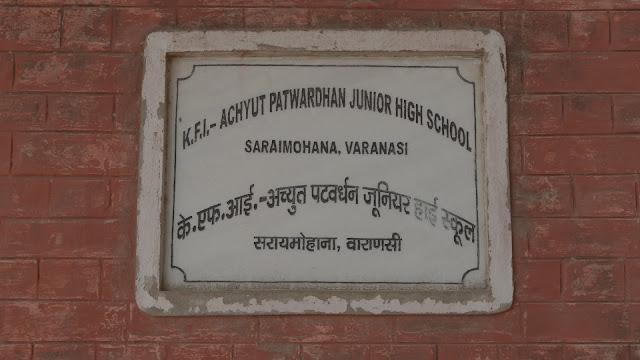
Surrounded by openness This piece finds place in Teacher Plus' December issue.  Thanks to the colleagues there and to Richa for comments on the draft.  Image credits: Achyut Patwardhan Junior High School  What all can a school do if its building is surrounded by open spaces? How can the adults and children at the school optimally use these spaces? Does greenery at these open spaces become the proverbial icing on the cake? Do these spaces lead to rekindling openness within us as well? First the school. Located on the outskirts of a fast-growing town, along the riverbank in eastern Uttar Pradesh, the school began sometime in the 1940s. Housed within a large campus, the school today has 15 teachers and 250 children. Most of the children, from nursery to 8th class, come from the nearby areas. There are no other open spaces in the vicinity and these spaces around the school play a crucial role in the lives of the children. They come to these spaces during evenings, on holiday...

Schools and their neighbours

Image
  Schools and other institutions   This finds space in Teacher Plus December 2023. Thanks to colleagues there and to Richa for comments on the draft.   We often discuss how adults and children interact with each other or how they interact amidst themselves in school. Let us look at how these adults and children together, in other words - the school, interacts with some of its neighbours. We will also explore if these schools could benefit from higher intensity of engagements than those currently in vogue.   https://www.freepik.com/free-vector/exterior-museum-hospital-police-station-post-office-government-bank-school-theatre-university-city-town-halls-cartoon-vector-illustration-set-house-construction-building-facade-concept_21683710.htm Image by pch.vector</a> on Freepik Public-institutions like banks, post-offices, railway-stations and bus-stations Many of our schools have banks or post-offices or transport stations in their vicinity. With m...

Learning from large campuses

Image
Walking Education Campuses Nimesh Ved and Sanjay Dwivedi Published at The Hindu Education Plus . We thank the team there.  We also thank Pawandeep Kaur for the image.    Learning during the schooling years warrants moving beyond the conventional classroom set-up as well. This is all the more crucial in a society like ours that seldom invest time and thought towards expanding the child’s horizons. Exposure visits can help meet this need. They enable learning in a non-formal and fun-filled environment. Multi-day trips to mountainous and forested landscapes are, of course, a wonderful option. Financial and logistical challenges however ensure that these trips are out of bounds for majority of our schools. Many schools are then left with the option of going out, with children, for some hours in and around their towns and cities. Some schools visit spaces like museums and events like book-fairs . A few also venture to the banks and factories. One option we have e...