Posts

Pieces from past

Image
As Pankaj (Sekhsaria) and I continued out telephonic chats over the book ( Protected Area (PA) Update – A Compilation ) we discussed how we would break the monotony and make the book interesting. The book, in the first section, moves from one state to another; each of the states was to have information collated from the PA Update. We felt the need to bring in an introduction of sorts to the state. List of PAs was needed but stand-alone it appeared somewhat dry and the pieces (which form the second section) were out of contention since a healthy number focused on the ‘region’ as opposed to a state in particular. A sketch map for each state was agreed upon and then we also decided to cull in ‘historical pieces’ for each state. Together these three (sketch map, list of PAs and the historical piece) would ‘begin’ each state in the book. While the word-limit that we agreed to made me feel, at times,  I was doing anything but justice to the piece I loved put in many an afternoon g...

Nagaland : Lions and Tigers

Image
Lion centric debates, in recent weeks, have been triggered by the Supreme Court verdict that could finally see lions in Kuno (Sheopur) and Valmik Thapar's "Exotic Aliens : The Lion and the Cheetah in India" which questions these two species as ever having been local. During a recent trip to Nagaland I came across both Lions and Tigers on the walls; while Tigers occur in the state the presence of Lions (on the walls) was surprising for sure! Share some images below ~ These are from the Tourist Lodge at Ungma (Mokokchung) These from a hotel in Mokokchung  And these from 2 separate villages in Zunheboto  (miss the names now and dont want to postpone the post) R A Lorrain's 1912 classic '5 Years in Unknown Jungles' mentions lions in south Mizoram; look forward to interesting readings and interactions on Nagaland!

Agraa ~ Bal Mela

Image
Memories from the past  Share fun and energy of Bal Mela we organized during 2004 at. This was at Samrakshan's Agraa field base  in Sheopur, Madhya Pradesh.  Bal Mela : February 2004  Once the date for the Bal Mela was finalized, during the month of January things started falling into place and everyone in the team began chipping in with their efforts, individually as well as through weekly meetings. The way we perceived it, the Bal Mela this year was to be a litmus test for the dictum "how we do a task is more important that what result we bring out from it". To put this belief into practice, we tried to ensure that a large part of the arrangements for the event were taken care of by the teachers and the village level workers. The  role of the Samrakshan coordinators was  limited to tying the loose ends and overall coordination. It was really invigorating to see the village level workers and teachers allocate responsibilities among them...

Phuye - Interactions on CCA Mapping

Image
We started with a film . This would keep boredom at bay for participants who had arrived on-time as also help lay a platform for further discussions. The film " A Hunter's Tale ", that I have facilitated screenings earlier too,  held the participant's interest ~  Some of the participants then got on to identifying species in the field-guides. As we wondered on how Hoolock Gibbon and Hornbills were charismatic species from participant's perspective as well, it dawned on us that only the elders were then vocal! On asking the young participants we got to know that none of them had seen either Hoolock Gibbons ( Ashuai)  or Hornbills ~ As the participants arrived we moved on to Prayer and Introduction by the Nanga Greener Zone (NGZ) Committee; Governing body of Community Conserved Area (CCA) that spans 14 Sema villages ~ Participants had questions for us as well as the Committee. These ranged from whether GPS units would be provided for each village ...

A civet and a spider

Image
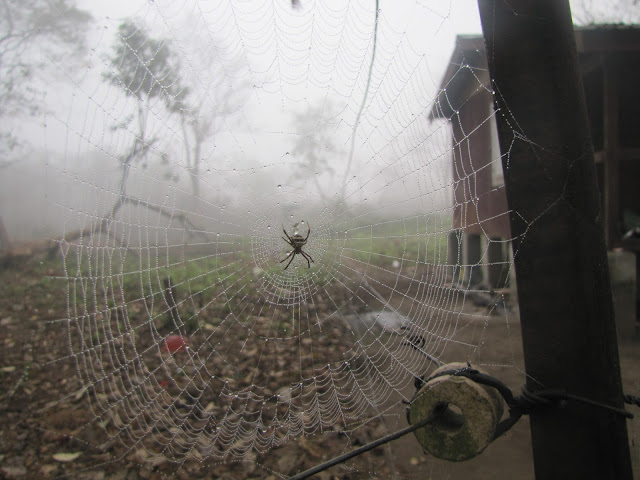
This happened one February 2013 day near the Bansbari gate :  Manas National Park (Assam) ~ Civet ~ In the evening as we ( Yaranajit, Kamal and I ) sat discussing in the hotel lawns one of the hotel staff came to ask if we had a camera – there was a kind of wild cat around the place where fire-wood was stored. As we walked in the direction we saw one of the staff tap the firewood stock with a bamboo taller than the tallest amongst us. This could have scared the mammal, encouraging it to hide. Couple of minutes later a domestic dog sensed something ‘wrong’ and arrived at the scene to announce his loud presence. This could have resulted in the fear of the hiding personality crossing its tipping point and we saw a scared Large Indian Civet ( Viverra zibetha ) take tentative steps from behind the firewood. Before we could see it for a brief while and admire its beauty the blessed dog got into action and started chasing it. Startled, not knowing what else to do, I ran after ...

Driving down a forested lane: Elephants and other memories of the Garo Hills.

Image
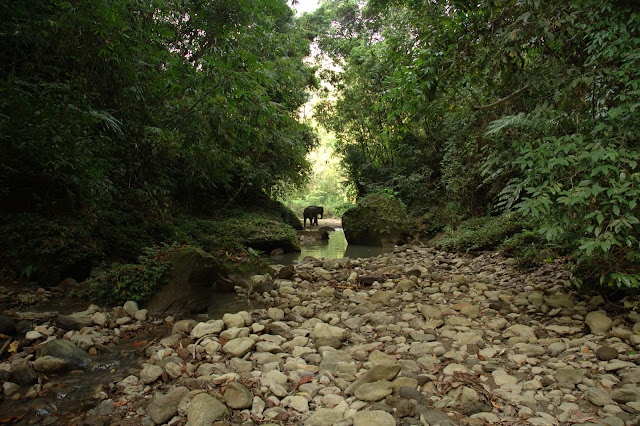
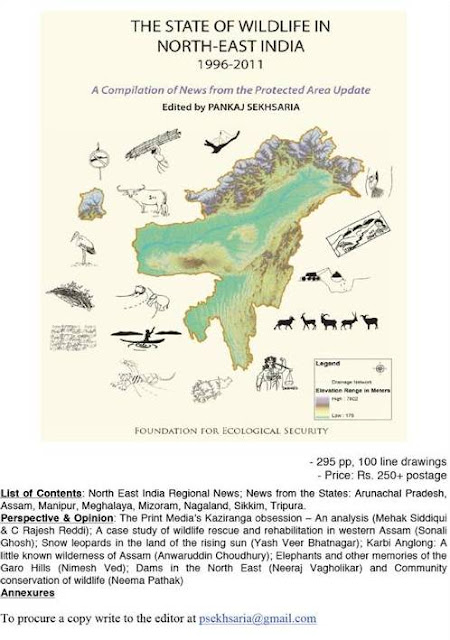
Driving down a forested lane:  Elephants and other memories of the Garo Hills. This piece is published in The State of Wildlife In Northeast India (1996 - 2011) : A Compilation of News from the Protected Area Update . My bike stopped at the very place it used to then. I would either have to push it a little or kick-start it to reach the next turn from where Panda was downhill. Panda lies on the India – Bangladesh border in South Garo Hills and abuts the Baghmara Reserve Forest (BRF). As I drove on I relived moments from my three year (2004 - 2007) stint in the landscape; some of which I happily share below. The Garo Hills Landscape I was at Baghmara after a hiatus to review the efforts at Samrakshan and my only condition was that I would take a day off to drive around with a bike. Samrakshan Trust is based at Baghmara and works towards conserving biodiversity values in an equitable and just manner. The Garo hills along the India-Bangladesh border are compris...

Protected Area Update - Compilation : A Flier

Image

Phuye - Some Moments

Image
Mosaic that greets one enroute Phuye; town, shifting-cultivation and a range of mono-culture plantations including the amazing kiwi . .  Water availability is an issue during the dry months in Phuye; damage-control (here) was apparently not very effective . .  A Shield Bug; looks smart with orange tipped antenna and sometimes releases  substances with unpleasant odour . . ( thanks Geetha Iyer for help on this )  Space to park . .  This watch at the Community Hall fascinated at first sight . . A snack with few parallels . .  Many thanks to people of Phuye

Phuye - A Church

Image
From across the village ~ At the gate ~ Arc gracing the door ~ Door allowing the morning light in ~ Plant adorning the wall ~

Phuye - Some Homes

Image
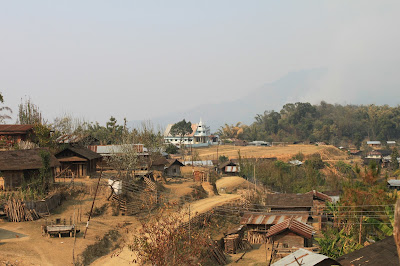
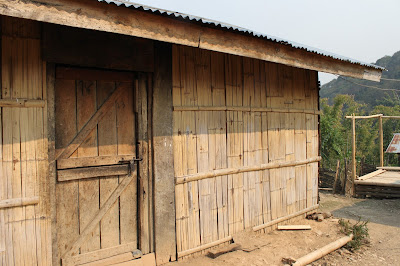
Images are from a recent trip to Phuye ( Zunheboto , Nagaland ) while text is from J H Hutton's seminal 1921 publication ' The Sema Nagas '.  Homes, so different from each other, stood out, reminding one of the skill-sets and simplicity of those they belonged to. At some of these we were lucky to have tea and meals. Sema villages being as a rule very much  smaller,—a village of 100 houses is quite large for a Sema  village — the cultivated lands are nearer to the village and  the fighting men more easily assembled in case of a raid.  The approach to a Sema village is always over land consisting  largely of open jhum, and in part of very thick low  jungle, in which the movement of an enemy would be most  difficult. The arrangement of the houses in a Sema village is looser  and more open than in an Angami village, and the scattering  of the houses is conducive to greater cleanliness and decreased  danger from fire....