Posts

Planning to educate, Educating to plan

Image
Pleased to share our paper presented at ESD for transforming education for children and youth organized by CEE at Amdavad during September, 2016. Title: Planning to educate, Educating to plan: Conservation Education in an ecologically critical landscape. Authors: Nimesh Ved, Jayanta Pathak, Firoz Ahmed and Bibhuti Lahkar. Corresponding author: Nimesh Ved: nimesh.explore@gmail.com Need: The authors, especially Nimesh Ved and Firoz Ahmed, had during the recent years, had a series of conversations on Conservation Education ( CE ). These conversations besides raising questions on CE also highlighted stark weaknesses in CE; including in actions undertaken by the authors. A significant portion of these actions focused on generating stand-alone material and made attempts to reach out to maximum numbers. In addition, the belief that CE is an easy activity which can be taken up by anyone with good intentions appeared to be pervasive! With some trepidation, we woul...

A House for All

Image
This piece finds space in The Hindu Sunday Magazine today. Thanks are due to Lamakaan, Nayeem and Subba Reddy.       Open House. Image: P Jeganathan Some weeks ago I was discussing alternative spaces and cultural centres in our cities with a friend, and she asked what was so special about Lamakaan , the not-profit open cultural space in Banjara Hills. The answer I had then come up with was a rather drab one. Something about the place being different, that it warranted a trip to understand it, that it had a certain ‘something’. Then, a week ago I saw a woman, possibly in her 50’s sitting on the raised platform in a room at Lamakaan. She looked comfortable in her saree, adjusting it once in a while, as she read, absorbed, from her laptop. Suddenly it struck me: this is why Lamakaan is so special. It makes all of us, irrespective of age, class or gender, feel comfortable in our skin, at ease. Image: P Jeganathan  I remembered how I ha...

Discussing Culling

Pleased to share of the workshop at SCCS on Culling Culling: Beyond the sound and fury Date - 22nd September, 2016 Time - 2.00 pm to 4.30 pm "Recent culling orders stare at all of us in the face; however barring a few, the students, researchers, conservationists have largely been silent on the topic. While the press has ‘dropped’ the issue for now, chances of culling being extended to other areas and species are high. This discussion session will attempt to bring out what we ( students, scientists, conservationists ) could have done and more importantly, what we can do now?" Select readings: The Culling Fields The debate over culling in India requires more than just sound and fury Previous workshop at SCCS: Demystifying Conservation Education

The Weavers

Image
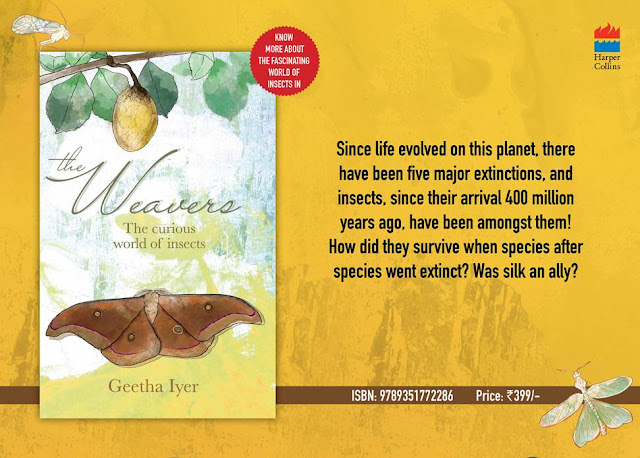
The Weavers The curious world of insects. Geetha Iyer HarperCollins Publishers India. 2016. At Phuye ( Zunheboto, Nagaland ), with a friend, I had had honey, fresh with the honeycomb. An old uncle, smiling as he came all of a sudden, had brought it on a plate and we were left gaping. I happily recall how, once we began, we finished it no time. I was reminded of this, when in chapter 5, ‘Silk in Ants, Bees and Wasps’ the author asks, ‘ Have you ever eaten a freshly harvested honeycomb? ’ and states ‘ If you have, then surely you must have also eaten silk; if you haven’t, please try. The comb with the honey is tasty, fresh and delicious! She then adds ‘So the next time you feast on juicy honeycombs, remember that you are probably also gorging on a mixture of bee shit and bee piss ’. C A Viraktamath, in his foreword , has succinctly described the book as, ‘a wonderful treatise on all silk producing insects’ . In her introductory note the author says ‘ It’s not...

A tree died

Image
There was a tree Is it a Kingfisher? Can you spot it? I catch a glimpse, movement amidst the rain washed leaves, A welcome diversion, beauty of its brown, blue and white, Perks of sitting at the balcony, at Lamakaan. Today, only a week later, I sit at the same table,  notebook - pencil in hand, Drizzle and samosas accompany the chai, But the bird has gone. Strong machines are cutting the tree, Slow cruel sounds, of technology strangling nature, A killing, of the kind we allow, or A metaphor, like the crumbling haveli in ‘In Custody’. Now in pieces, it is carried away by mortals,    The bird loses its Makaan. Images are of the tables at Lamakaan. Thanks Anuradha for the images.

Planning to educate, educating to plan

Abstract title: Planning to educate, educating to plan: Conservation Education in an ecologically critical landscape. Conference: ESD for transforming education for children and youth Authors: Nimesh Ved, Jayanta Pathak, Firoz Ahmed & Bibhuti Lahkar Communicating author: Nimesh Ved: nimesh.explore@gmail.com Abstract text: Conservation education efforts across the country have been severely restricted by lack of adequate resources and absence of long term planning. As a corollary we have well intentioned individuals and organizations organizing disconnected events during wildlife week and environment days. Stress has been on generating stand alone materials and reaching out to higher numbers as opposed to coming up with a cohesive long term plan and strengthening capacities to implement the plan. We understand there is a dire need to have a long term plan for conservation education in place. A plan that is not only sensitive to loca...

The debate over the culling of wildlife in India requires more than just sound and fury

Image
The lack of research on the topic is stark. The situation is complex and one that warrants time and attention from multiple stakeholders. A few months ago, the Union environment ministry asked states to submit proposals if they wanted to declare as vermin certain wildlife species that were causing harm to crops, property or human life. Declaring theses species as vermin would allow state and forest authorities to kill these animals without attracting penal provisions under the Wildlife Protection Act, 1972. Subsequently, three states were given permission to designate as vermin species that were proving to be a nuisance to humans. These were   wild pigs   in Uttarakhand,   nilgais and wild pigs   in Bihar and   rhesus macaques in Himachal Pradesh. A species can be declared vermin under Section 62 of the Wildlife Protection Act, 1972. Once this happens, the species moves to Schedule 5 of the Act and loses protection under the law. The recent mass ...