Posts

Culling: Where are we headed?

Thoughts on culling after the discussion session last month. Timeline December 2015 the Bihar state government for the first time since the Wildlife Protection Act came into being ‘used’ Section 62 of the Act to declare Nilgai and Wild Boar vermin. This was followed by Uttarakhand in February 2016 for Wild Boar and Himachal Pradesh in March 2016, followed by another one increasing the geographical spread during May 2016, for Rhesus Macaque. These allowed for their being killed, using multiple means, in large numbers. Spat between two central government ministers helped highlight the issue and it was extensively covered by media during June 2016. Scenario today What numbers were to be killed to bring conflict to acceptable levels? How many animals were killed in each of these states? Has the culling had any impact on the conflict situation? While all this happens we are yet to get answers to some of the seemingly basic questions. It is easier to move ahead...
Dampa: Some Questions

Image
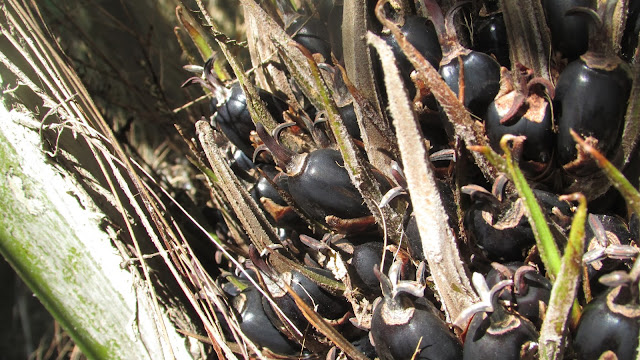
Have you seen Oil Palm in Tiger Reserve? And other questions on Dampa This is the unedited version of the piece published in Deccan Herald . Recent trips to Dampa have been followed with a series of interesting questions, by friends, on the landscape. Dampa is often referred to as being different from other Tiger Reserves be it management or tiger sightings? Why is it so? There are multiple reasons. To begin with, Dampa is not an atypical Tiger Reserve in the lines of Ranthambore or Corbett where one enjoys a drive a four wheel vehicle; here one walks up and down the forest. On sightings the Indian Express during September 2015 reports ‘ Senior forest officials in the state and conservationists who have worked there admit there have been no tiger sightings in Dampa for decades, and no tiger has been caught by numerous camera traps although a large assortment of other wildlife — including smaller wild cats — has been .” Management issues include lack of single managemen...

Re-imagining Environment Education

Is environment education in India at odds with its development agenda? Published by Firstpost on 18 th October 2016. Acknowledgements:  Firstpost and Jaideep. One of the plenary speakers at a recently held  conference on Education for Sustainable Development (ESD) in Ahmedabad highlighted the need for Environment Education (EE) to be political. EE had been away from politics for long and this, she said, had rendered it weak. Participants were quick to raise questions on the risks this could pose of complicating the issue further, especially given the ability of the facilitators to deliberate on such topics. The speaker’s response was unambiguous. On one hand, students today have access to most of the information – from the internet and other sources. On the other hand, the onus lies on the facilitators to upgrade their skills and communicate the issues responsibly in an apt manner. In other words, not talking on the topics was neither an opti...

Planning to educate, Educating to plan

Image
Pleased to share our paper presented at ESD for transforming education for children and youth organized by CEE at Amdavad during September, 2016. Title: Planning to educate, Educating to plan: Conservation Education in an ecologically critical landscape. Authors: Nimesh Ved, Jayanta Pathak, Firoz Ahmed and Bibhuti Lahkar. Corresponding author: Nimesh Ved: nimesh.explore@gmail.com Need: The authors, especially Nimesh Ved and Firoz Ahmed, had during the recent years, had a series of conversations on Conservation Education ( CE ). These conversations besides raising questions on CE also highlighted stark weaknesses in CE; including in actions undertaken by the authors. A significant portion of these actions focused on generating stand-alone material and made attempts to reach out to maximum numbers. In addition, the belief that CE is an easy activity which can be taken up by anyone with good intentions appeared to be pervasive! With some trepidation, we woul...

A House for All

Image
This piece finds space in The Hindu Sunday Magazine today. Thanks are due to Lamakaan, Nayeem and Subba Reddy.       Open House. Image: P Jeganathan Some weeks ago I was discussing alternative spaces and cultural centres in our cities with a friend, and she asked what was so special about Lamakaan , the not-profit open cultural space in Banjara Hills. The answer I had then come up with was a rather drab one. Something about the place being different, that it warranted a trip to understand it, that it had a certain ‘something’. Then, a week ago I saw a woman, possibly in her 50’s sitting on the raised platform in a room at Lamakaan. She looked comfortable in her saree, adjusting it once in a while, as she read, absorbed, from her laptop. Suddenly it struck me: this is why Lamakaan is so special. It makes all of us, irrespective of age, class or gender, feel comfortable in our skin, at ease. Image: P Jeganathan  I remembered how I ha...