Posts

Tiger Conservation: A Hard Talk

Image
Title The Rise and Fall of the EMERALD TIGERS:  Ten Years of Research in Panna National Park Author Raghu Chundawat Publisher Speaking Tiger Published at First Post on 3rd October 2018 here .  Thanks are due to the team at First Post.  The Rise and Fall of the EMERALD TIGERS: Ten Years of Research in Panna National Park by Raghu Chundawat is the story of a passionate wildlife scientist and one of the better known tiger reserves in the country. It depicts both – the scientist’s research and monitoring work during his association with the tiger reserve and the troubles he faced after he let the cat out of the bag by pointing out to major mismanagement in the tiger reserve. To begin with the author has the guts to call a spade a spade. He is a rare species in the wildlife conservation world where keeping shut is the norm. The sector is infamous for not speaking up – be it to protect permits, or maintain liaisons, or ensure funding or e...

Bridge with a history (and a heart)

Image
Bridge over the River Ganga Published in the Hindu Sunday Magazine on 7th October 2018 here . A new bridge has been announced over the Ganga in Banaras. The old one, they say, is close to collapse, and needs an overhaul or rest. Last year, a report found the bridge to be in critical condition. In 2016 it had seen the infamous stampede that resulted in the death of some 20 people. It’s difficult to put a number to the trains and vehicles that would have crossed the Ganga on the 130-year-old Dufferin Bridge. Two railway tracks, a wide road, foot-paths on either side, and a graceful grandeur matched with robustness. A structure befitting the Ganga and Banaras; not as easy task. Multiple plaques, a testimony to the structure’s history, tell stories.  Dufferin Bridge was named after Lord Dufferin who was the Viceroy of India when it was completed. In 1948, it was renamed Malaviya Bridge after Madan Mohan Malaviya, the founder of Banaras Hindu University. It has othe...

Banaras : Lassi

Image
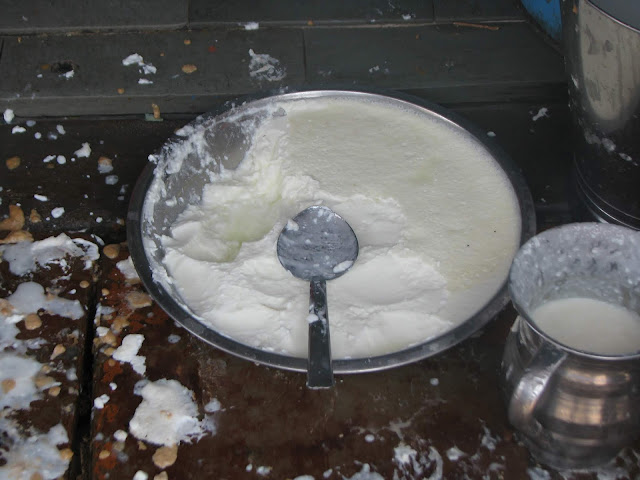
Last week a friend offered us 'packaged' Lassi ( when we declined aerated drinks ) and my immediate response was - surely we are not having those in Banaras, People coming to the town are guided by its God places, we have been guided by its Food places, much like birds and mammals our movements are guided by availability of food, though unlike them it is for reasons other than survival,  Lassi is one 'food' which gives immense pleasure and we have often been spotted pedaling around town to partake some during varying times of the day, and seldom has the ratio of people to kullads been 1 : 1, Like a lot else in life Banarasis take their Lassi seriously, debates on the best places in town to savour Lassi are not uncommon, one often encounters angry- loud responses, Stories abound of how - during the past - the sellers used to be strict of their Lassi not being wasted and used to - not very politely - tell customers to drink water in the kullad ( after th...

Nature education today: Some questions

Image
Nature education in schools: Where do we stand?   Thanks are due to the team at Teacher Plus and the hosts and co-participants of the event for this piece published in August issue of Teacher Plus. At a recent gathering on nature education, participating school teachers raised pertinent questions, some of which I discuss briefly below. A majority of teachers were part of schools that have ‘nature’ higher on the list of values they ascribe to than ‘competition’ and boast of campuses which other ( read regular ) schools can at best dream of. Outdoors.   Most of us agree that the ‘outdoors’ present a far more conducive setting for nature education than the ‘indoors’. However, the ‘outdoors’ also warrant a different and seemingly more difficult set of skills. Walking around and recognizing, touching, smelling, tasting leaves and learning of their usage from people whose lives they are an intricate part of – all the while keeping the students hooked - is diffe...

Campus : Mushrooms

Image
" In pursuing an understanding of the human-fungus connection, I realized that one of my favorite ancient cultures treasured mushrooms just about as much as I do. This little synergy delights me to no end, especially because the Romans approached mushrooms with all the flashy, semi-glorious and semi-reprehensible behavior that was a major hallmark of their culture. " Mushroom Anna More on her blog here ~  Rains have the mushrooms do what they are good at, mushrooming ~  Earlier memories pertain to the local names providing humour : બિલાડીની ટોપ, कुकुरमुत्ता ~ During days in Meghalaya and Mizoram stories of hunters losing lives on account of eating 'wrong' mushroom species were not rare ~  Then, of course, the debate of whether consuming them made one 'non-vegeterian' ~  As of now, some of us find them cute ~  And they appear to appreciate our efforts at mulching ~ 

Campus : Flowers

Image
~ Fallen beauties ~ More than a few trees we have  Be it numbers or species diversity Biased towards some we are  Like the Pakhads near the dairy But there is one tree which stands out  Near the school we see it stand tall  Its flowers say it all  How I wish I could climb the tree And see them up there  Or lie with them  As they elegantly caress the ground  Fallen beauties these  Graceful even after the tree lets them go

Glimpses of the South Rajasthan Wilderness

Image
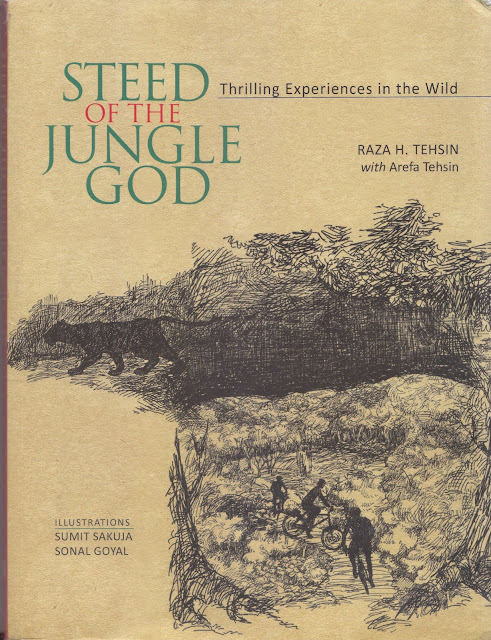
Title: Steed of the Jungle God – Thrilling Experiences in the Wild Author: Raza Tehsin with Arefa Tehsin Illustrations: Sumit Sakuja and Sonal Goyal Publisher: National Book Trust, India First Edition: 2018 Price: 575/- ISBN: 978–8 –237–8145–7 Pages: 142 Number of stories: 20 This Review was published by First Post on 29 th June, 2018 here . Thanks are due to the team at First Post. Steed of the Jungle God: Thrilling experiences in the Wild contains stories of the forests written by someone has put in lot of time in and around them. The author Raza Tehsin is well versed in natural history, loves jungles and like many before him who have done so, retains his humility. These stories, spanning more than half a century, tell us how the natural world around us has changed during the period. The author points out how the scenario prior to Independence was very different; most of the lakes in Mewar were almost full throughout the year, many rivers and nullahs...

Banaras : Musical Ghats

Image
As Varanasi's ghats come alive with music, the city could stake its claim to being India's cultural capital This piece was published on FirstPost on 27 th June, 2018. Thanks are due to the team at FirstPost. Bathing to purify oneself of sins, the final rituals of the dead, boating, evening  aartis ,  sadhus , and hippies are among the things that come to mind when one thinks about the  ghats  at Varanasi. Seldom, however, does music find a place. This, when the town could well boast of yet another tag — that of being the musical capital of the country. Raj Ghat is at one end of the eight-kilometre stretch of  ghats  along the Ganga, and Assi Ghat stands at the other end. Each of these  ghats  is on the side of the Ganga that touches the town. These famed  ghats  play host to a majority of events, some which are relatively new, such as the Kabir Festival which had its second edition during November last...