Posts

Mundeshvari – History, Archaeology, Devotion . . .
Image
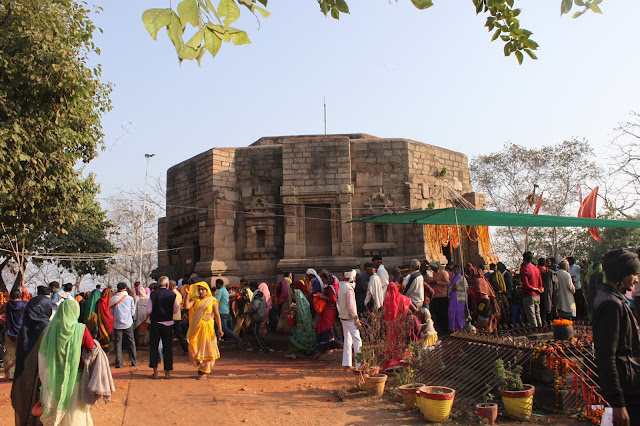
Mundeshvari temple: History in every stone An edited version of this piece has been published in the Friday Review .  Many thanks to colleagues and friends together on this trip, Fiona Buckee for sharing her paper and the team at The Hindu. Mundeshvari Temple is considered the oldest functional temple in the country - I came across this clichéd sounding line multiple times. And questions arose. How old is it then? Is it older than Banaras and its temples? Banaras with all its history, mythology and umpteen temples. Few more questions arose and then I forgot all of them. Mundeshvari is located in Bhabua - 100 kms from Banaras. I then landed upon the temple again in Saba Dewan’s classic Tawaifnama where she writes: ‘Some recent scholars are of the opinion that the goddess installed in the Mundesvari temple might well have been a deity worshipped originally by the aboriginal population described in the Vedic and post-Vedic texts as asura and daitya. In the long-drawn-out struggles ...

An old world warrior in a new world battle

Image
Title: Second World War Sandwich Author: Digonta Bordoloi Cover: Haitenlo Semy Pan Macmilan India Price: 399/- Pages: 231 First published: 2021 ISBN: 978–93–89109–52–8 Thanks are due to Digonta Bordoloi , Pan Macmilan India , Sunny and Swati.   Background During my first visit to Nagaland, silly enough, I missed out a visit to the war memorial. The second trip, however, I made amends. The place is special. Every subsequent visit I made it a point to visit it with - time on hand. There, sitting in silence, amidst the graves, I felt a strange calm. Calm I have experienced only at a few other places. This book took me there. It again told me why the war memorial exists. What all a place which emanates peace and serenity today has seen in the past. The horror of violence and brutality at close quarters. It reminded me how little I knew of the battle that could have possibly altered a lot – including our map - had the result been otherwise. This book, a work of fiction, is a well-resea...

A Banyan that was

Image
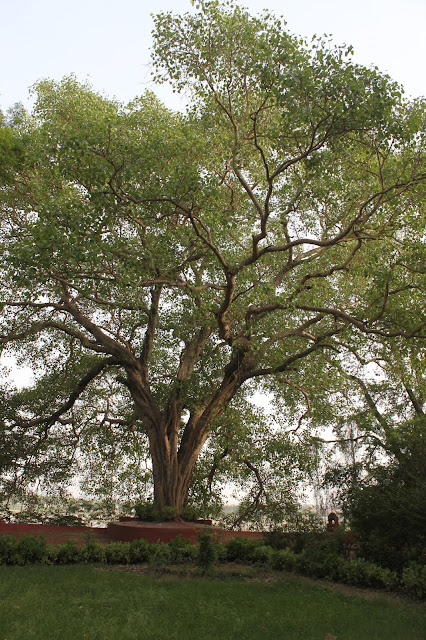
What cutting of one tree in Banaras tells us? Few days ago, the newspapers talked of one particular tree that fell. A Banyan in Banaras. Large number of people expressed anguish and some also considered it a harbinger of bad times for the town. Perplexed, I wondered what bad omen meant for a town ravaged by Covid? Amidst the pandemic driven chaos Banaras has, during the past few weeks, been witness to corpses lined up outside crematoriums and floating on river waters. And also, why one particular tree got the attention it did? Especially given that, around the same time, the news from the Capital, talked of treed avenues being destroyed. Of the uprooting and probable relocation of around 400 trees - including Jamun and Neem – some of those aging around 100 (years). A Banyan still standing (representative image from elsewhere) Image Credits: Dharmendra Khandal  The tree under discussion was the Akshay Vat - the indestructible Banyan tree . Only 2 such trees now remain - one at Gaya...

With the Peepal

Image
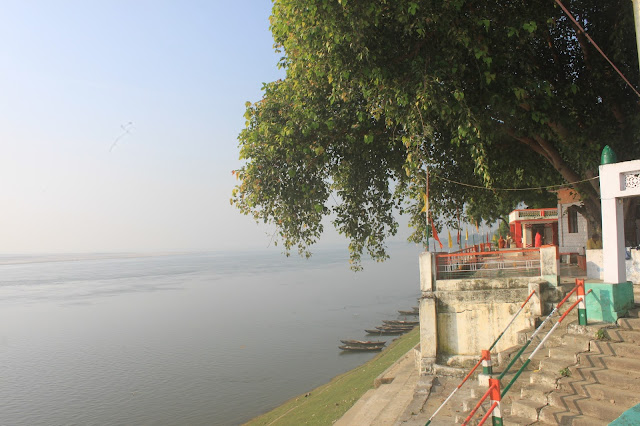
A very special spot The Peepal is at the fulcrum here. Initially this tree felt like a person I am familiar with. Today it is a friend I am comfortable with. One I like to share silences with. The tree stands mid-way between the edge of the river and the verandah where I often sit these days; ie when I am not sitting beneath the tree or walking in the vicinity. At the same height as the verandah, it stands at the edge of the slope which rolls, away from the verandah, down to meet the river. The Ganga. At Banaras. It appears unbothered by the other plants and trees around – other than of course the Neem which stands some feet away. But it does appear to tilt, as if in reverence, towards the river. Naresh Saxena in one of his poems talks about space – the need of space to enable better relations, stronger bonds. The Peepal appears to have that space and bonding with the river. From the verandah I many a time notice the buffaloes wallowing at the opposite banks. For all our talk and st...

Parallel worlds: Of animals and humans

Image
The Silence of the Hyena Stories and a novella Author: Syed Muhammad Ashraf Translated from the Urdu by: M Asaduddin and Musharraf Ali Farooqi Publisher: Aleph Book Company Year of publishing: 2020 Pages: 218 ISBN: 978-93-8983620-2 Price: 599/- Where the animal and human worlds meet! Thanks are due to The Purple Pencil Project and Aleph Book Company. This collection – originally written in Urdu - consists of 8 short stories and a novella. 2 translators have brought these stories to English. One of them the novella, which consists of almost half the pages of the book, and the other translator, the short stories. There is no mention of either time or location in most of the stories. However, they give a feel of being located - further from cities and nearer to forests - in a world as it occurred some years ago. A world that was not in a rush, where hunting birds was acceptable and where 300/- meant a significant sum of money. Interestingly, excepting one, which came out about a decade la...

Beyond the clichéd north Indian village

Image
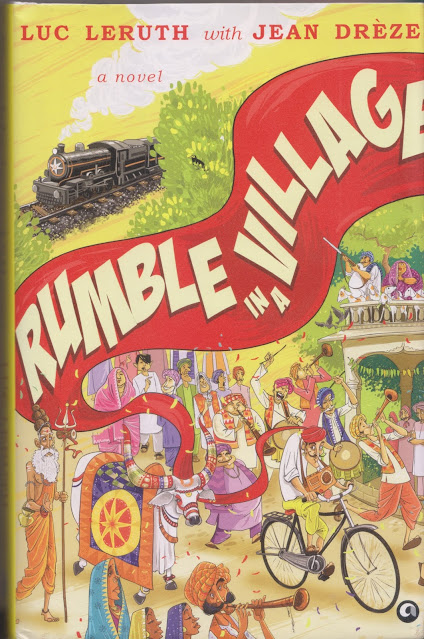
Rumble in a Village Authors: Luc Leruth with Jean Dreze Published by: Aleph ISBN: 978-93-89836-12-7 Number of pages: 292 Year of Publishing: 2020 Price: 699/- Cover Illustration: Mohit Suneja This review was published at the Purple Pencil Project . Many thanks to the team there. Fiction often allows subject specialists to explore ideas and topics in inventive ways, far removed from the restrictions that research papers ask for. Many talk about taking the fiction route but few end up taking it up and rare are those who manage it with a flair. Rumble in a Village, by Luc Leruth and Jean Dreze is exactly one such book. Set in rural North India, and borrowing heavily from Jean Dreze’s experiences as a development economist.  Throwing everything cliche about a sleepy old village out of the window, Rumble in a Village, is, as Nandana Sen has testified on the cover, “ disturbing in its truth ” and “ infectious in its humour ”.   The book begins with a pho...

Ancient ghat, Holy river and an Irony

Image
An encounter with the elusive Gangetic dolphin in northern India A slightly edited version of this piece appears at The Third Pole . Acknowledge and appreciate the time taken out by Samir Sinha, Nachiket Kelkar, Venkatesh Dutta, Zak Klausner and of course the team at The Third Pole for enriching this piece. Dhakwa In summer 2020, I caught glimpses of a creature I had never seen before, at the point where the Varuna and Ganga rivers meet in the holy city of Banaras. It was early evening, and I was looking at the monsoon flood waters. I have had many memorable birding experiences at this confluence. Banaras, in the north Indian state of Uttar Pradesh, is famous for its ghats (series of steps leading down to a river), and I often go to Aadi Keshav Ghat, the site of the ancient Aadi Keshav temple. Brown- and black-headed gulls migrate here in large numbers. On some occasions smaller flocks look like paper boats swaying on the water; on others larger gatherings are like a wall arising from ...

A Bhojpuri novel in English

Image
Phoolsunghi Author: Pandey Kapil  Translator: Gautam Choubey  Publisher: Penguin – An imprint of Penguin Random House  Year of publication: 2020  ISBN: 9780670095193  Pages: 162  Price: 399/-  At the onset I confess that neither have I read Phoolsunghi in its original form nor have I read any other book in Bhojpuri. However, the current place of my stay – also my birth place – allows me to be amidst Bhojpuri. Listening to it flow at one level and discussing it at another. Dr Ganesh Devy’s statement on Bhojpuri, also mentioned in the introduction, also struck. ‘Bhojpuri has not only stayed alive . . in the whole world, Bhojpuri is the most rapidly developing language’.  Few months ago a colleague had pointed out how Maithili – as a language – has been accorded the status and respect which Bhojpuri, though more than deserving, continues to be deprived of. Reading further about the author and the characters had me wonder on this. During a brief con...

Walking the Earth’s Spine

Image
Some books take you on a journey, Some remind you of the journeys you have already taken, This book does both. Title: Into the Heart of the Himalayas Author: Jono Lineen Publisher: Speaking Tiger Books 2020 (India edition) First published as Walking the Earth’s Spine in Canada by Pottersfield Press 2012. Also published in Australia by Melbourne University Press 2014. ISBN: 978-81-944468-2-8 Price: 499/- More on the book at The New Indian Express and Mumbai Mirror . Some lines - from the book - I read and re-read. After the silence of the plateau the water’s constant roar was intrusive. Slowly, over a day of walking beside it, the river’s hum absorbed me. Everything else became peripheral. I lost track of time; the sun moved overhead. I focused on the single footstep ahead of me and gradually, from behind the rush, a rhythm evolved. It was not water or wind; it was a thumping pulse. ^^ I was alone. I had walked for 8 hours that day. I had been walking for 3 month...

Dances with the leaves

Image
Notes from under the peepal   An edited version of the piece finds places in The Sunday Magazine. Thanks are due to the team at The Hindu . Acknowledge Dharmendra Khandal and Shakti Kumar for suggestions on the draft. “ पीपर पात सरिस मनु डोला ”, is what Tulsidas wrote in the Ramcharitmanas about their poetic movement, said a friend, as I stared at the Peepal leaves. I sat, silent and smitten, amazed yet again, at this swaying of Peepal leaves. The poet, in the epic’s Ayodhya Khand, had allured to a wavering mind, the friend added.     From distance these swaying leaves appear like happy children playing while a closer view makes me wonder if this is how wind chimes at the Pearly Gates look like! They, when caressed by the wind, indeed play a joyous note. It is a special feel to rest my back against its trunk and look at the sky - netted by its dangling leaves. With the Peepal it is more of sitting with the tree rather than sitting under the tree.   Int...