Posts

Leafy talk

Brooming away Previous post on the topic Most Sunday’s I wake up to the sounds of cleaning, of brooms pushing leaves. A sound that makes my hair stand on end! Men, most of them in the second halves of their lives, brooming away with an energy that they seldom display otherwise. They consider leaves as trash akin to plastic disposables and are happy to burn both plastic and leaves together. For some of them, each day is a Sunday. What does one do? Label this as brahminical and sound woke? Question that rare ‘house-work’ which men take up with rigour and earn the wrath of women? Wish that these men took up some other activity? Meditate? Assume that the activity is meditative for the ‘broomer’ – this is difficult given that, most if not all, ‘broomers’ carry that ‘venting out frustration’ and the ‘do not mess with me’ look! My neighbourhood is not an exception. Once, at the sprawling campus of an NGO I had asked why were leaves being removed? Were they not a part of the ground, grass and...

Two books

Image
On a recent trip to Kalimpong came across two books at the library at Buddha Pada , These books ~ ~ are short, stark and uncommonly simple, ~ can be read anytime, from any page, ~ very different, yet not so, ~ are as stark on re-reading as they are when first read,  ~ connect to incidents in our lives - as we read, ~ have a common message at the crux - life is simple, we often complicate it, ~ tell us work on ourselves, before we venture to solve the world's problems,  By Duc (pixiduc) from Paris, France. - Thich Nhat Hanh Marche meditative 06, CC BY-SA 2.0, https://commons.wikimedia.org/w/index.php?curid=19478461  The Miracles of Mindfulness :  Thich Nhat Hanh There are 2 ways to wash the dishes. The first is to wash the dishes in order to have clean dishes and the second is to wash the dishes in order to wash the dishes. People usually consider walking on water or in thin air a miracle. But I think the real miracle is not to walk either on water on in thin ai...

A tryst with trust

Image
  Taking stock of books (and ourselves) When kids help in taking stock of books Text and images: Anshumalika Rai and Nimesh Ved Published at the Deccan Herald .   What happens when we go with our guts and trust children? A quick look at our school before we jump on to the details. We focus on languages , Hindi and English . The book room is a favoured place; many of the 250 children and 15 teachers can be seen reading here. Children of classes 7 and 8, the senior most children, also join us in taking care of the book room. The idea is to deepen their engagement with books . This year we got a tad ambitious. The annual stock-taking turned into a project: 1 room, 5 days, 1,500 books and 30 children of class 7. As we look back, we realize, that throughout the project it was not the children assisting us, as we had once envisaged, but the other way around - we were assisting the children. This brings smiles to our faces and reminds us of P L Travers’ , “ you should t...

Allahabad Again

Image
Let us begin with the previous post previous post on the town  That was BC - aka Before COVID Since I have been to the town for the book-stores : Vaani and Rajkamal . Here, I also look forward to are the times at Indian Coffee House (nicely located between these two book-stores) and Bushy's .  I, with colleagues, have also made trips to the G B Pant Insitute for its museum ,  This time we began with the library, one of the more stunning libraries for sure - when it comes to buildings, as a  Kader Khan or Sharabi film fan would have said: लाइब्रेरी की बिल्डिंग हो तो ऐसी,  वरना  ना हो  The park with it multiple resources reminded me of Kamati Baug ,  This board was also the first time I read of map being referred to as मानचित्र The park also has its share of quirkiness  Image: Dheeraj It also houses  The Allahabad Museum ,  There has been work done here as well since I last visited, especially the new interactive galleries and the h...

Kalimpong Again

Image
Posts from the previous visit Walking Food Gods and Flowers Eating places The dining hall at  Buddha Pada , a place to sit,  to do nothing , The table outside, took me to evenings in  Saiha . Was fun to sit here for long, to eat, to write, To soak in Kalimpong at Café Kalimpong Coffee places Locally grown – roasted - ground coffee, an ease in the ambience, And, welcoming conversation at the Himali Aroma Cafe . Reading places At Buddha Pada,  Amidst those by Dalai Lama, Thich Nhat Hanh, and others, I came across  Kalimpong: Where the mules quenched their thirst Museums Tharpa Choling Monastery houses a café, a souvenir shop, a library, Besides, of course, the museum. One that reminded me of the museum at Aligarh .  The Lepcha Museum , not far from the Gangjong Handmade Paper Factory   These private museums , a world apart from the large ones, but equally important for preserving our heritage. Reminded yet again - so many manuscripts we have to save, to...

Books on Banaras (2)

Image
Previous post on the topic Glimpses from the past ~   Sarai Mohana.  1940. Some of the young people began asking for a library. Ethel applied for a grant and pressed the College Trust into donating a piece of land. The young men themselves decided to build the Reading Room in their off time and found used bricks for the purpose. While the men built, Ethel planted oleanders and made paths, making the front yard into a playground. In the end, she says, they had a very charming library. They got books and magazines, daily and weekly papers from various offices. The Reading Room became a popular feature of the village, until the day-school teacher, who Ethel was discovering was quite a faction-maker with his own ambitions, tried to take it over for a night school for children to make extra money for himself.  In the census of 1872, the occupation of all males above 15 years of age are noted. I give some of the items.  Alms-takers: 184 Beggars: 3,490 Barbers: 979 Pun...

Together, learning languages

Image
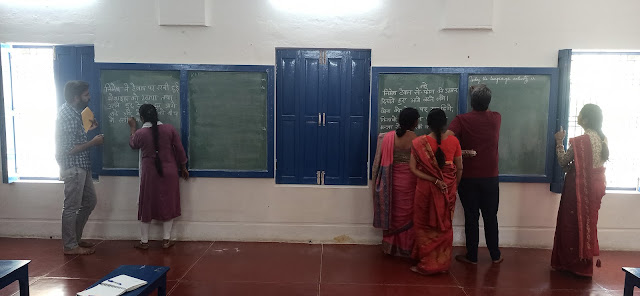
Learning languages together This piece finds place in the Deccan Herald . Thanks to the team there. Thanks are due to colleagues for being together during the journey, the questions, and sharing not only confusions but also memories.  Thanks Richa for the comment on the draft.  Some time back we initiated capacity building sessions for teachers at our school. These sessions focus on English and Hindi; languages.   10 out of the 15 teachers at the school teach languages; they are the participants. Our school is located in peri-urban eastern Uttar Pradesh; these teachers converse in Bhojpuri. Today, while it is not easy to pinpoint what has worked and what has not gone right, it is not difficult either to discern the positive energy these sessions have or the learning they enable. Looking back and gleaning through the journey is fun; we have experienced more learning, more surprises than we had bargained for.   Sessions. Together the 11 of us walked the langua...

Walking together: Hindi and English

Language conundrum This piece appears in The Hindu . Thanks to the team there. Can two languages walk the road together – hold each other’s hands and grow? Can we begin with our schools? Two colleagues recently went for some workshops. The organisations they applied to sent not only the application forms but also the follow-up emails in multiple languages. The entire communication was in two languages — English and Hindi. This set me thinking. Is this the way out of the Hindi-English conundrum? We are part of a Hindi-medium school in eastern Uttar Pradesh, and like many other schools in the landscape, we are grappling with the conundrum. Over the years we have either pitched one language against the other or as an alternative to the other, and, as a corollary, have been left struggling at both. I talk about Hindi, but I would hazard a guess that the scenario is not very different with other regional languages and dialects as well. In other words, ‘Hindi’ can well be replaced with ‘regi...

A tree like none other

Image
Pal pal peepal  No theory, no gyaan comes to mind as I stand and look at this tree each time i visit CHITS The only line that does is Majrooh Sultanpuri's classic bahon me chalo aao And it is as stunning from the 'other' side too Previous posts on trees Pakhad Peepal Campus trees Peepal in Banaras Banyan in Banaras Akshay Vat

Sarnath : Stupa

Image
Sarnath on an early morning  Some places take special form at select times, this campus (managed by the  ASI ) is a different world altogether during the mornings ~ Did the Daniells –  Thomas and William  - paint during this time of the day? Is this why  Diana L Eck  calls Banaras – City of light? Neem flowers on the morning grass, fun it is to lay alongside these and watch the Stupa ~ There are nooks and corners that hold surprises, once in a while one comes across changes as well ~ There is something special about this, have little idea about it, but the experience of standing in front of it and look at it was good ~ Just outside stand new installations, whether these were needed is debatable, but now that they are there can one take time out to experience, figure these ~ Previous post on Sarnath  here Other monuments in Banaras Dufferin Bridge Sanskrit University Laat Bhairav