Posts

The Peepal of Banaras

Image
Peepal along the Ghats   The Ghats of Banaras boast not just of temples, akharas, steps ( and more steps ), hotels ( and so on ) but also trees. Here too, like at many other places, the Peepal stands out.  Right from the north at the Krishnamurti Foundation India's campus to the temple at Tulsi Ghat ( abutting Assi ) - the Peepal registers its presence along the Ghats.   Gaay Ghat  The early morning light makes the Ghats more special!  A light which is difficult for mortals like me to capture in clicks or words! Swimming camps used to be organized here ( during summers ) before masks came to our lives! Hanuman Garhi Ghat Two Peepal's stand next to each other at the Akhara!  Do they also join the Akhara proceedings I once wondered! This Ghat is the point we can walk up to ( from Rajghat ) when the water level is high! Bundi Parkota Ghat  This is where we crane our necks to admire the Peepal! Where does the tree gets its food and water from - a colleague...
Tomb of Lord Cornwallis

Image
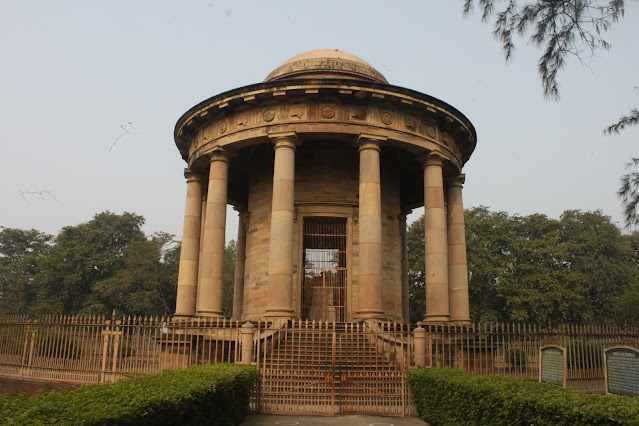
A Governor General's Tomb in Ghazipur One of my first memories of the monument is a conversation between two colleagues. Wahan kya hai asked one. Ek angrez tha - woh sala wahan ghoom raha tha tab mar gaya - uska makbara hai : came the response. A fan of direct talk I ended up finding more about the moment and ultimately visiting.  Amidst the haze and chill of the winter morning the grandeur of the tomb reminded me of the parliament building. Much smaller in scale but a structure that visually stuns, appeals. Nico Slate writes thus in Lord Cornwallis is Dead: The Struggle for democracy in United States and India ; Outside the city of Ghazipur, an hour east of Varanasi, the tomb of Lord Charles Cornwallis overlooks the Ganges. A marble dome, seventy-five feet high and sixty feet in diameter, the Cornwallis mausoleum embodies the ambitions of the British Raj. While the Ganges swells and shrinks, the stone crypt holds firm. Cornwallis would be proud. As governor-general of British In...

Sasaram

Image
Sher Shah Suri's Tomb How did they visualise this then? A structure in the middle of a pond! Locally known as Paani Rouza Sher Shah Suri's tomb is beyond stunning. The tomb is Located in Rohtas ( Bihar ) - about 125 kms from Banaras. On our way back from the tomb it struck us that we were driving on the Grand Trunk Road - one that Sher Shah Suri had built.  Would the makers have known then that centuries later it would be Sasaram's claim to fame, provide refuge to local young folks ( there are walk-paths around the structure and pond! ) and have people come to pay respects, to pray.  A structure large yet not intimidating (is it the water! ) and grand yet accessible. ASI's curbs on boating and carrying plastic inside seem to have helped keep the water clean.  When we have maintained the monument so well can we also pay more attention to signage? To what introduces us to the monument, to the first object we sight as we enter the monument.  Moving beyond the Tomb...

Nepali Mandir

Image
A temple with a view Some places I am glad that I have been to. These places I revisit to sit in silence. This is one such place. A door with bells! A temple which stands out including for its craft and aesthetics in Banaras, a town of temples, has got to be special.  Here, artists have created magic with wood. The Cambridge dictionary describes wooden (adjective) as awkward or disapproving. People who coined this have possibly not been here! Lights, Camera, Window! This replica of the Pashupatinath Temple at Kathmandu was spruced up recently for the visit of the prime minister of Nepal.  The gherua walls and 'wood' appeared to be happily welcoming the sun. Playing with the morning light! One morning a colleague and I were affectionately offered curd, banana and sweets as prasad. As I thanked and figured out a place to sit a monkey (efficient fellow!) ran away with the sweets. He was silent, quick and happy. Bird on a tree! A board on the stairs asks people to not smoke at th...

Jaunpur: Of Masjids and Imartis

Image
  Jaunpur and the magic of Sharqi architecture   This piece finds place in Sunday Herald .  Thanks are due to the team at Deccan Herald .   Warm thanks to Sanjay D, Dheeraj, Kumar, Siddhartha and Sanjay M for being together on the trips.     Some images from a previous post on Jaunpur – here .   What it is about these old and large masjids that one experiences a unique peace and calm here- a colleague asked. They also appear strong enough to stand tall for another few hundred years at least – remarked another. Three of us were at the Jami Masjid in Jaunpur.   We had driven from Banaras. 75 kms. From the town we took the road heading to the airport and went further. Rail is another option: Jaunpur is on the Lucknow – Varanasi route. However, despite this proximity to and connectivity with Banaras Jaunpur lags far behind on the tourism front. Is this despite Banaras or because of Banaras we wondered.   On the other hand, ...

Sanskrit University

Image
  Gothic Architecture in the heart of Banaras For Banaras’ past one goes to Diana L Eck’s Banaras: City of Light This is what she writes on the place In education, the British years brought a change from the ancient pandit-student pattern of learning which had predominated in Kashi for 2,500 years. In 1791, the Governor-General, Warren Hastings, who had presumably recovered from the indignities of his flight from Banaras, approved the proposal of Jonathan Duncan for a Sanskrit College in Banaras, where Sanskrit texts would be collected and pandits employed. In 1853, the present buildings for this college were erected in a Gothic style strikingly out of place in Banaras. The Sanskrit College, preserving the most traditional Hindi learning, was oddly called Queen’s College. This is what James Kennedy had to say about the place in Life and work in Benares and Kumaon (Shristi Book Distributors, New Delhi, 978-93-85088-44-5) In 1853 a very fine Gothic structure, said to b...

Book room, the story ahead

Image
    Books in the time of COVID   Anshumalika Rai and Nimesh Ved   This piece finds place in Teacher Plus’ February 2022 issue. Thanks are due to the team at Teacher Plus and colleagues for the questions (below) and more.   In the July 2020 issue of Teacher Plus we shared the initial steps of our journey of launching the Book Room. A few months after the launch COVID struck. In this article we talk about our experiences during the COVID times.     A colleague from a sister unit, during one of his visits, asked - as we discussed a book that had just arrived – to the students of which class will you give this book to read?   One of us responded thus - we do not tell the children which books to read, they decide . As we revisited the conversation, we realized that we had moved a few steps towards understanding children, books and the two together. This conversation had taken place after the students began coming regularly post - ...

Learning from (being amidst) books

Image
  Book fairs and book stores as learning spaces Nimesh Ved and Anshumalika Rai Published at Deccan Herald. Thanks to the team there, to the book store teams that allowed us to put in time with books and to friends who accompanied us to the book fairs. Trips to book-stores and book-fairs during recent times have had us wonder why these are not looked at as learning spaces. Not as much as they warrant for sure. We have come across children and teachers at book-fairs but these appear more of exceptions given our numbers and the immense potential these spaces harbour. But first, what we do at these spaces. Let us begin with the book-fairs. The sheer numbers of books we see at the annual book-fair at Dilli we have not come across elsewhere. Images of people squatting on the floor, chatting excitedly about books and carrying bags full of books have stayed with us since. The smaller book-fairs, like those at the university campuses in Banaras, were different. Here we noticed ...

Of Ragas and Mudras

Image
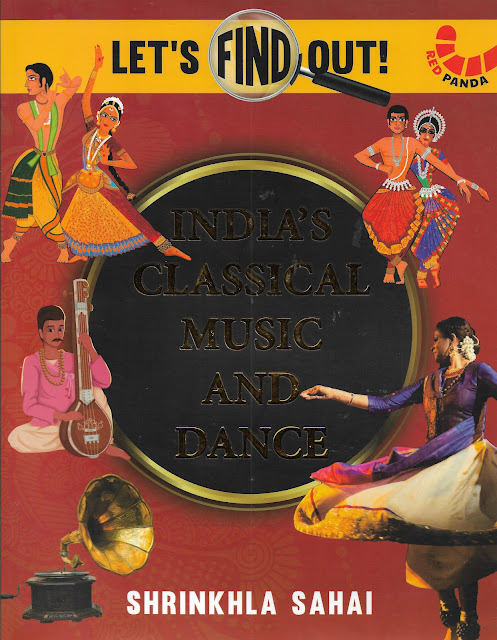
  India’s Classical Music and Dance Shrinkhla Sahai Publisher: Red Panda (An imprint of Westland Publications) Year: 2021 ISBN: 9789390679065   About the book Number of pages: 87. Sections: 3 ( Introduction, Indian Classical Music and Indian Classical Dance ). All pages are in colour and there is an extensive use of both – illustrations and photographs. Topic: Not an easy book to come out with - especially given that many of us would have heard of these arts but few would have clarity on. And, of course, the potential details that one could venture into. Presentation: The book carries a informal and non-serious look. This is welcome considering that many, especially those not associated with dance and music, have a not-easy-to-explain fear of the classical arts.   Price: 399/-. Very reasonable given the production quality.   Where I stand I am neither a performer of Indian Classical Dance or Indian Classic Music nor have I read on the topi...