Posts

Ancient ghat, Holy river and an Irony
Image
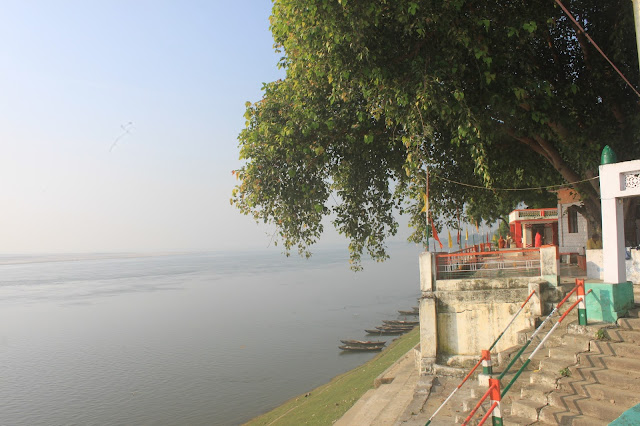
An encounter with the elusive Gangetic dolphin in northern India A slightly edited version of this piece appears at The Third Pole . Acknowledge and appreciate the time taken out by Samir Sinha, Nachiket Kelkar, Venkatesh Dutta, Zak Klausner and of course the team at The Third Pole for enriching this piece. Dhakwa In summer 2020, I caught glimpses of a creature I had never seen before, at the point where the Varuna and Ganga rivers meet in the holy city of Banaras. It was early evening, and I was looking at the monsoon flood waters. I have had many memorable birding experiences at this confluence. Banaras, in the north Indian state of Uttar Pradesh, is famous for its ghats (series of steps leading down to a river), and I often go to Aadi Keshav Ghat, the site of the ancient Aadi Keshav temple. Brown- and black-headed gulls migrate here in large numbers. On some occasions smaller flocks look like paper boats swaying on the water; on others larger gatherings are like a wall arising from ...

A Bhojpuri novel in English

Image
Phoolsunghi Author: Pandey Kapil  Translator: Gautam Choubey  Publisher: Penguin – An imprint of Penguin Random House  Year of publication: 2020  ISBN: 9780670095193  Pages: 162  Price: 399/-  At the onset I confess that neither have I read Phoolsunghi in its original form nor have I read any other book in Bhojpuri. However, the current place of my stay – also my birth place – allows me to be amidst Bhojpuri. Listening to it flow at one level and discussing it at another. Dr Ganesh Devy’s statement on Bhojpuri, also mentioned in the introduction, also struck. ‘Bhojpuri has not only stayed alive . . in the whole world, Bhojpuri is the most rapidly developing language’.  Few months ago a colleague had pointed out how Maithili – as a language – has been accorded the status and respect which Bhojpuri, though more than deserving, continues to be deprived of. Reading further about the author and the characters had me wonder on this. During a brief con...

Walking the Earth’s Spine

Image
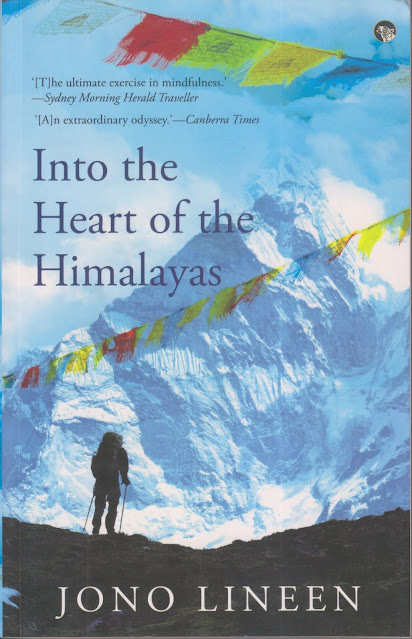
Some books take you on a journey, Some remind you of the journeys you have already taken, This book does both. Title: Into the Heart of the Himalayas Author: Jono Lineen Publisher: Speaking Tiger Books 2020 (India edition) First published as Walking the Earth’s Spine in Canada by Pottersfield Press 2012. Also published in Australia by Melbourne University Press 2014. ISBN: 978-81-944468-2-8 Price: 499/- More on the book at The New Indian Express and Mumbai Mirror . Some lines - from the book - I read and re-read. After the silence of the plateau the water’s constant roar was intrusive. Slowly, over a day of walking beside it, the river’s hum absorbed me. Everything else became peripheral. I lost track of time; the sun moved overhead. I focused on the single footstep ahead of me and gradually, from behind the rush, a rhythm evolved. It was not water or wind; it was a thumping pulse. ^^ I was alone. I had walked for 8 hours that day. I had been walking for 3 month...

Dances with the leaves

Image
Notes from under the peepal   An edited version of the piece finds places in The Sunday Magazine. Thanks are due to the team at The Hindu . Acknowledge Dharmendra Khandal and Shakti Kumar for suggestions on the draft. “ पीपर पात सरिस मनु डोला ”, is what Tulsidas wrote in the Ramcharitmanas about their poetic movement, said a friend, as I stared at the Peepal leaves. I sat, silent and smitten, amazed yet again, at this swaying of Peepal leaves. The poet, in the epic’s Ayodhya Khand, had allured to a wavering mind, the friend added.     From distance these swaying leaves appear like happy children playing while a closer view makes me wonder if this is how wind chimes at the Pearly Gates look like! They, when caressed by the wind, indeed play a joyous note. It is a special feel to rest my back against its trunk and look at the sky - netted by its dangling leaves. With the Peepal it is more of sitting with the tree rather than sitting under the tree.   Int...

Waking up to a sweet

Image
A Mouthful of Heaven A slightly edited version finds place in TheHindu Sunday Magazine . Thank you : The team at The Hindu, Richa and Kumar.   Image: Nimesh Ved Sometime last year, during a book launch, I got to interact with the author after listening to his eloquent talk. He, a European, in turn, asked me if my name meant ‘that yellow coloured soft sweet which is had in the mornings’. I was already a fan of Malaiyo, which fits the description, but could not figure out what he meant!   A few weeks later, a friend asked if my name meant a Lucknowi dish available only during winters. A sweet similar to the Daulat ki Chaat she had had at Old Delhi. Vir Sanghvi’s account of the street food festival , at Delhi, where Banaras took the honours, had prompted her question. By this time, I was intrigued and looked up more on Malaiyo, Daulat ki Chaat and of course Nimish. It turns out the dish also has a fourth name – Malai Makhan.   Ashish Mamgain in his article ‘ If you could eat...

Where Art and Trees meet

Image
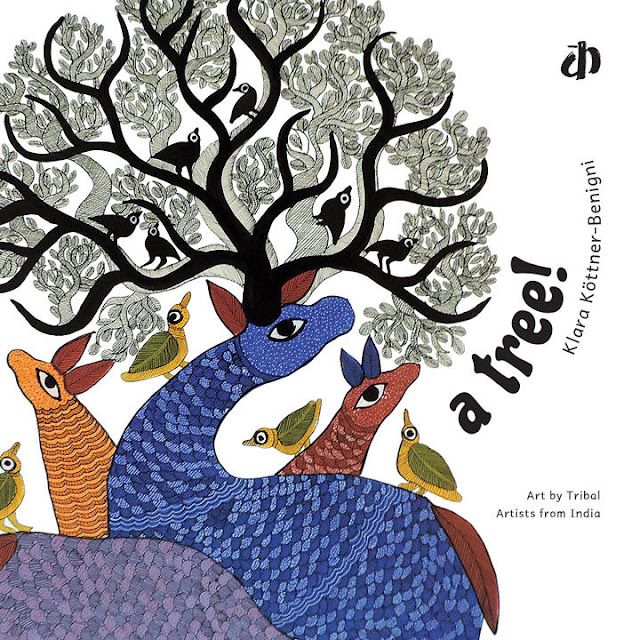
a tree Adopted from the poem by Klara Kottner-Benigni Art by tribal artists from India Published by: Katha Year of Publication: 2019 ISBN: 978-93-88284-14-1 Price: 195/- Acknowledgements: Katha The art work makes make an impression from the cover itself. It is stunning - to put mildly. Richness of the art work matches that of the subject. Nature is vibrant and colourful as brought out by the art work.   These images, by 10 different artists, span across distinct indigenous art forms. They bring out, like indigenous art forms do, the interconnectedness of various life forms. From elephants to fishes, they are all there – and look happy to be with the trees. They remind us that human lives too revolved around trees – from food to religion to dance and more. They also convey that when a tree dies it is not just a tree which dies – a lot goes away with it, a lot more withers away. The art work will make you fall in love with trees and if you are already a tree...

Bir . . Beyond Paragliding . .

Image
Bir . . Cafes, Monasteries and more . .  A fun place to walk and cycle is how I would describe Bir in a line. I treasure my walks in and around Bir the most. Slow and aimless walks where both the mind and feet wander. The phone stays shut. The gentle slopes and friendly smiles too have a role to play.   The first time I read of Bir was a few years ago in The Outdoor Journal . I recall being stunned by an image that showcased humans and birds in the same frame – both up in the air. I understand Bir’s reputation as THE place for paragliding in the country, and beyond, has only strengthened since. It is an experience to lie languorously on one’s back and look at people glide towards what is referred to as the ‘landing site’. Billing is where the take-off spot is.   By Dave Kleinschmidt - https://www.flickr.com/photos/dklein/2281407256/, CC BY-SA 2.0, https://commons.wikimedia.org/w/index.php?curid=15455538 Let me chat about the Bir beyond the flying and landing hum...

In harmony with books

Image
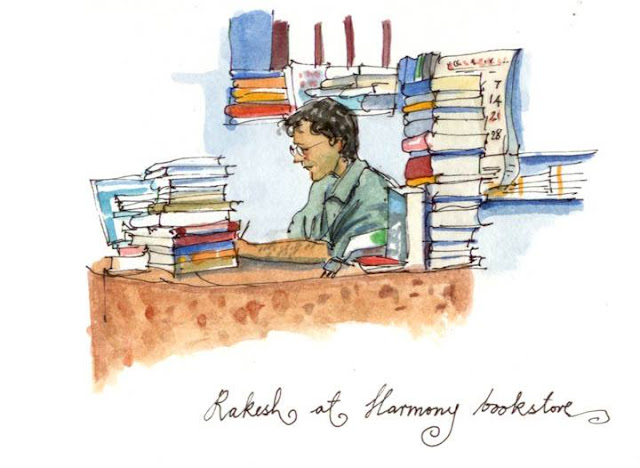
Friends, Conversations and A Bookstore in Banaras  Warm thanks to the Purple Pencil Project .  Why does he not stock books in Hindi and those for children? A friend I had gone with to the Harmony Bookstore asked me. I pointed her to Rakeshbhai - the curator and owner of this deceptively quaint bookstore. “If I keep Hindi books I need to have a range and number that does justice to the customers and the collection; it makes little sense to have only few books in Hindi,” – Rakeshbhai responded. Similar for books meant for children. “I can suggest bookstores” he added. The Lonely Planet refers to Rakeshbhai’s labour of love as ‘The best bookshop in Varanasi, with a particularly good selection of titles on Varanasi and the Mughals’. Another website praises the ‘poetry collection’. Dayanita Singh too, referred to it as ‘a story in itself’. Illustration: Prashant Mirinda After one of my initial visits (which was incidental) I came across an article by Rakeshbhai where h...

Hearing the unheard

Breaking the Gender Barrier: Not as tough as we assume A slightly edited version of this piece finds place in the Deccan Herald  here . Thanks are due to the team at Deccan Herald. Thanks are also due to Richa for inputs on the first draft.  Indebted to the colleagues for their support.     This discussion is based on recent experiences at a peri-urban school (up to 8 th standard and approximately 300 students) in eastern Uttar Pradesh.   Few months ago we had members from a sister unit come and enquire why the school had asked female students to practice sports at weird times. This, they added, would not go down well with the students’ families and could also lead to unpleasant situations. Teachers discussed the issue and then did what many a time works well in such situations – abstain from reacting. These members were not the only ones to offer such advice!   One of the teachers had encouraged students to practice kabaddi. These students beg...

Laat Bhairav: A guarded deity

Image
Notes from Laat Bhairav And edited version of this piece appears in the Hindu Sunday Magazine . Thanks are due to the team there.  I am indebted to Ajay Pandey, Rakeshbhai and Shagufta Siddhi for taking out to help with the images. And of course the photographers – Devendra Singh and Beat Niederer.  Image: Devendra Singh Newspaper reports had got me intrigued of the place. They had images of Ramleela being played on one side and prayers being offered at the idgah on the other. Descriptions went like ‘To the east of the platform Ramcharit Manas ’ chaupais were sung while to the west Namaz took place’ and ‘on the one hand azaan took place and on the other Narayan muni went on with his Narayan, Narayan as the Ramleela played’. This is the Laat Bhairav in Banaras. Couple of colleagues I talked with had never been there. Both of them stayed less than 5 kms from the compound! The third colleague I asked conveyed that I could access it from the road that branches towar...